Showing posts with label Art. Show all posts

30.11.11

SOLON MAINE, VIA CHINA AND ROME


On the first Sunday in November, the weather was gray and indifferent, not pleasant enough to encourage outside chores, not bad enough to stay inside with a book.   Even as I was contemplating this dilemma, knowing that outdoor chores were really the correct answer, the phone rang.   It was Sidekick, in much the same mood, wondering if I might be interested in a road trip 'up' to the Colby College Art Museum in Waterville (although actually due west a couple of hours, like all trips inland in Maine, it feels 'up').  Road trip with a favorite partner in crime or chores?  The decision took about 1.3 seconds.

On the outskirts of China, a Greek Revival farmhouse with beautiful Ionic columns
 
Further down the road, this handsome whitewashed brick Federal was once the summer home of Ellerton Jette, who was the chairman of the Hathaway Shirt Company, whose long defunct factory was once Waterville's major employer.  Here was housed much of the collection of American art that Jette later donated to  the Colby Art Museum.
For those too young to remember, 'The Man in The Hathaway Shirt' was one of the most successful ad campaigns of all time.  Hathaway was a small regional manufacturer when Ellerton Jette went to David Ogilvy, then arguably the most powerful man in advertising, with a tiny budget and convinced him to take on the Hathaway account.  The rest is history.  When the Dilettante was little, Dunham's of Waterville, with its rows of pastel oxford button downs was where we all got supplied with our Hathaway shirts and Bass Weejun loafers.
Not quite two hours later, after a drive through China, we arrived at Colby. The  campus is a handsome one, created in the 1930's.  It is a classic of its era, the creation of one Dr. Bixler, then the ambitious president of what the then small regional college.  Sitting on  Mayflower Hill, its Georgian buildings and quadrangles were inspired by the great early Universities, including Harvard and the University of Virginia.

The original 19th century Colby College Campu
The centerpiece is the Miller Library, a  Colonial Revival building with a whiff of Independence Hall in its architecture.  191 feet high, it was, until the 1970s the tallest building in Maine.  (Since you ask, the current tallest building is an apartment building in Portland.  At 203 feet, it ranks 46th or 47th---depending on how you interpret the Wikipedia information---among each State's tallest buildings.  Only Vermont, North Dakota, and Wyoming rank higher, I mean, lower.)

The Miller Library on the 'new' campus at Colby College, for years the tallest building in Maine.
We parked and strode to the museum entrance,  only to be confronted with a chain link fence with a sign that said 'Closed for Renovation until November 8th'.  We had checked the schedule online before leaving home, and on the museum's schedule page found no evidence that the museum was anything but open.  As it turned out, the closure was mentioned on the home page, but we had googled 'schedule', thus by-passing that page.  You'd think those smart people at the museum would have troubled to mention it on their schedule page also, wouldn't you?  Thank-you.  So would I.  Especially on the schedule page.  Really.

The museum was closed to prepare for the construction of the new Lunder Pavilion, to house a collection of artworks donated by the Lunder family, heirs to the Dexter Shoe fortune.  While I find it a handsome design, I question the agressive way in which it breaks scale with the surrounding buildings.
Colby's collection is well worth the visit.  Among the works we didn't see that day are:

John Singleton Copley
Mrs. Metcalf Bowler (Anne Fairchild), 1758-1759
Oil on canvas
Gift of Mr. and Mrs. Ellerton M. Jetté
Winslow Homer
The Trapper, 1870
Oil on canvas
Gift of Mrs. Harold T. Pulsifer
John Marin
Stonington, Maine, 1923
Watercolor and charcoal on paper
21 3/4 in. x 26 1/4 in.
Gift of John Marin, Jr. and Norma B. Marin
Fairfield Porter
Stephen and Kathy, 1963
Oil on canvas
Museum purchase from the Jere Abbott Acquisitions Fund
Regrouping, we decided to save the day by going through Rome---and then continuing on to South Solon and visit the South Solon meeting house, with its amazing frescoed walls, for our dose of art.  

In Norridgewock, on the banks of the Kennebec, this 18th century tavern hangs on, barely....
Hungry, we stopped for lunch in Skowhegan, an old mill town on the Kennebec,  where a few years ago HBO filmed 'Empire Falls', based on the novel of the same name by Richard Russo, about...an old mill town.  The first time I went to Skowhegan, decades ago, the last log drive was taking place on the Kennebec---millions of logs being floated downriver for processing.  Not environmentally sound, but a stirring sight nevertheless.
The last log drive on the Kennebec.  In places, one sees the Kennebec as it appeared 240 years earlier, when Benedict Arnold led his troops upriver to Quebec during the American Revolution
The 'Empire Grill',  the old diner from the movie, had closed, and a sports bar offered no sustenance.  On the strip heading out of town, we found a family restaurant, in what appeared to be a converted Pizza Hut---the architecture is unmistakeable.  Perhaps here I should mention that a friend refers to the road out of Skowhegan as 'the driveway to Quebec', and one definitely senses the French Canadian influence in the area culture. 
For these two hungry tourists, the defining moment was when we spotted Poutine on the menu.   Somehow, in a lifetime of trying all foods bad for me, this one had eluded me, a Canadian logger favorite of French Fries covered with brown gravy (ever the effete elitist, I was about to type 'sauce', but in fact, it was gravy) and melted cheese curd, and in our case, crumbled bacon.  Appalling in concept, delicious in execution.

Poutine.  Okay, so it wasn't Lutece, but trust me, we licked the plate clean.
We reached Solon in the mid-afternoon bellies full, arteries clogged (did I mention that we also had the restaurant's home-made meatloaf sandwich, well prepared and delicious---comfort food on a crisp fall day,on the largest slices of bread I have ever, ever, ever seen?  It was a sandwich for Brobdinagians).  Solon is an old town, its streets lined with handsome buildings that have see better days.  In this part of Maine, the way of life is often hard, employment scarce, and the smug pleasures of the coast, romanticized and ordered to the satisfaction of the well to do, are far behind.

Up in the middle of nowhere:  the Solon hotel anchors the town.  A friend said 'Oh yeah, the Solon hotel.  R.E.M. played there'.  One learns to expect the unexpected in rural Maine.
As in most of early 19th century Maine villages in more prosperous times, the evidence of talented builders using Asher Benjamin's pattern books for inspiration can be found.  This lovely little Greek Revival doorway, complete with triglyphs and metopes (however oddly spaced in the apex of the pediment) can be found on a Cape on Solon's Main Street.  In this part of Maine, tin roofs are the norm

Across the street, this oddly shallow 19th century house, not even 12 feet deep,  is irresistable.
The road to South Solon
A handful of early 19th century farmhouses survive on this high ridge--this example has escaped modernization, and has yet another lovely pattern book door surround.   It sometimes seems that the early builders could do no wrong.
At the meeting house, we spent a happy hour marveling at the 1950's frescoes in the late afternoon fall light.  While there, we were charmed by the appearance of a young man who had grown up in the neighborhood and had brought his son to see the murals and the pew where his father had sat when he was a boy.   For a full account of the Meeting House and its frescoes, please click HERE


We decided to go home by way of Athens, and mapped out our trip, only to find that the road petered out to a single dirt lane.   With the light waning, we decided this was not the day to be lost driving about the woods of Maine, and turned around and head down to I-95.   All was not lost, though, for we were rewarded on that back road by this view of Saddleback Mountain and the Rangeley hills an hour distant.

Leaving the Meeting House, a rainbow illuminated a sky that echoed that of the frescoes within
The view from a field near Athens. 
(Skowhegan was also the home town of Maine's estimable Senator, Margaret Chase Smith. In this season of really silly presidential hopefuls, here story is worth recounting.  Click HERE for the Dilettante on Mrs. Chase)

20.4.11

PICASSO AND PIE DOWN EAST: Mid-Century Arrives in Maine

I live in a typical little coastal village in eastern Maine — although 'typical' depends on one's perspective. We live here amidst achingly beautiful scenery, made only more beautiful by the clear light refracted from the ocean. We have little white houses, and we have big white houses.  We have people and institutions: Lobstermen. Carpenters. Internet tycoons. Media personalities. Doctors. Lawyers. And maybe even Indian Chiefs. Our inhabitants include a woman who has legally changed her name to Jesus A. Christ. There is music, often performed by world famous musicians, as well as Saturday night contra dances at the Town Hall (in an auditorium named for my father, who does not contra dance). A Pentecostal Church, an Episcopal Church, and everything in between. We have an extraordinary library whose shelves hold the works of scores of writers who have lived here. We have boats: Shabby dorys. Fishing boats (fewer every year). Sleek yachts (more every year).

Main Street, as it appeared before Thompson & Heywood---and before Dutch Elm Disease
 I could go on, but you get the idea. We may look typical, but we're not. Fashion is usually secondary---We dress in L.L. Bean drag against the harsh realities of our weather, and though the dress at summer parties up here might not make the Sartorialist, at a dinner party you are as likely to be seated next to someone back from a diplomatic mission to Istanbul, or an editor at a renowned literary magazine as that lobsterman — who in turn might be the son of a famous poet, or the carpenter, who might also be a Juilliard trained musician. You might even sit next to me.

We also have artists, and world class cooks. Over the next few months, I'm going to mention a few of each. Today's post is a tale that combines the two.

The Arnold Wolfers House, 1947, by Walter Gropius & TAC
 In the 1940s, architect Benjamin Thompson, as a young member of The Architect's Collaborative, was in the area working with Walter Gropius on a project for international affairs specialist Arnold Wolfers (for more about that project, click HERE). Thompson's mother Lynne, a Midwesterner gone New York, was looking for a quiet place to write and came up to have a look, and stayed.  


Maine Street after Thompson & Heywood, with Pavilion at center.  For the story of the blacksmith shop at right, click HERE
Soon, she and her partner Dorothy Heywood, heiress to the Chester Shoe Company, had purchased a traditional French style manor house along the shore, at happily depressed post-war prices. They had Thompson’s son Ben, not yet the famous architect he would become, remodel the house, until it was no longer traditional or French. Mrs. Heywood had worked for the Betty Parsons gallery, and she and Mrs. Thompson had assembled a fine collection of modern art, including works by Picasso, Rothko, Motherwell, and Klee. 

The two women had big ideas, and a desire to do good in the community. Mrs. Heywood invested in Rowantrees Pottery, a well known crafts organization that had been started by Adelaide Pearson during the Depression to boost the local economy. Thinking beyond our borders, Mrs. Heywood opened a Rowantrees showroom in New York, also probably designed by Mrs. Thompson’s architect son.


Thompson & Heywood, as they were known in town, offered to show their collection of modern art at the library as a fundraiser the likes of which the town had never seen. To temper the radical art, home-baked blueberry pies were offered as refreshment, lest the sight of all that modern art offend too many. Mrs. Thompson was an enterprising sort, and decided that it would be jolly if she were to air-freight one of the pies to Picasso ('a rising Spanish artist who is becoming well known') in France, that he might partake of it even as one of his works was being unveiled in little Blue Hill, Maine.  History doesn't record if he did so (and trust me, idle curiosity has led me to check the index of more than one Picasso biography), or if the pie, more likely, arrived smashed and runny, but one is amused to ponder Picasso's reaction.
The show was controversial — our little equivalent of the 1913 Armory Show (there tends to be a time lag up here) — and a huge success. So were the pies. Emboldened by their adventure, Thompson and Heywood decided to start a business — the Rowantrees venture in New York had already folded — one that would combine art and food, as their fund raising exhibit had.

Architectural Drawing for the Pavilion, shows the complexity of Cooper Milliken's design (Courtesy Maine Historical Society, Eaton Tarbell Collection)
The pair purchased an old storefront on the village Main street, and added to it one of the most radical buildings of its day in Maine. The effect on the village was electric.  People either loved, or (mostly) hated it.  The architect was Cooper Milliken of Eaton Tarbell and Associates and The Pavilion, as it was called, gave yet another aesthetic jolt to a village hitherto known best for its simple 19th century white houses. Neither woman cooked, but Thompson learned, and took to it as a duck to water. 

The Pavilion under construction.  The frame was entirely mortised, Japanese style
At their first opening, all was gala, and even Betty Parsons and Robert Motherwell attended.

Whether they made money, ever, is doubtful, but their restaurant was a critical success, and everyone came, even the New York Times. I remember the place well from childhood — it was like catnip to me, so exotic and unlike anything else in our world.

Interior view under construction
I remember the scent of the exposed wooden rafters, cool slate floors, a wall of glass overlooking the harbor, the wildly distorted slopes of the walls, the smells of good food, the paper shades hanging from the ceiling the big handmade jewelry worn by the owners.

1950 newspaper photo of the recently-opened Pavilion. 
Only later did I learn that those shades were by Noguchi, and came from Design Research, the famous home design business started in 1955 by Lynn's architect son, or that the very plates on which one took afternoon tea of lemon cakes were from Denmark. The art was modern, consigned from the Metropolitan Gallery in New York, the sleek home furnishings for sale were consigned from Design Research, and all of it was unlike anything sold up here before.

A letter from Lynne Thompson to her architect, announcing the arrival of new goods (from son Ben Thompson's new Design Research store in Cambridge.
All good things come to an end, and by the 1960s Thompson and Heywood, exhausted, wound down the business, and in their seventies, moved to Cambridge, leaving only one local restaurant, the TA-CO (after Theodore, Alton, Cynthia, and Olive, the owners) with its baked bean Saturdays, the Drugstore lunch counter, and the Barnacle lobster shack as dining venues. All three are still missed by those old enough to remember.  As for the Pavilion, the building that many considered 'just too New York', it was demolished in 1966.
The story would end here, except that in 1965, Thompson penned a slender cookbook and memoir of the adventure, a marvelous little slice of mid-century style, Picasso & Pie.
In it she chronicled their times in the restaurant trade, their big adventure in bringing the new to Down East Maine, and most of all their recipes, many now delightedly dated, and adapted for the limited and simple ingredients.

They are based on many sources from old Maine & mid-western favorites to then modern cuisine and range accordingly from simple to sophisticated, and are still delicious. It is impossible for me to be objective — maybe it's a terrible cookbook (I don't think so) — but it's a slice of my childhood preserved, and I love it. Copies often show up on eBay, and to my surprise, one was on Amazon recently for $90.00. 
There's much more to this tale, including the amazing building and the Design Research connection, and you can read about it here in an article I wrote for the Portland Magazine. Should it be inexplicably unavailable at the local news stands in Kansas, the article can be accessed online by clicking HERE.

We'll go out with a some recipes from Picasso & Pie (c) 1969, (Price Stern, Sloan, Publishers). Remember, they’re from the fifties. I take no responsibility for reactions from food snobs:
BLUEBERRY AMBROSIA

2.5 quarts water
Thin cut peel of one lemon
Small amount of tangerine rind
Small stick cinnamon
½ cup sugar
4 cups blueberries
2 tbs. cornstarch


Simmer the blueberries, lemon rind and tangerine rind in the 2 ½ quarts of water until the berries are soft.

Strain and put the berries through a sieve or puree them finely in a blender. Return to strained juice. Mix the 2 tablespoons of cornstarch in about 1/2 cup of water and add to mixture.

Simmer 5 minutes.

Chill to iciness and serve with whipped cream which has been sweetened to taste. Dust the cream lightly with cinnamon.

Note: This Ambrosia belongs to the scandinavian Fruit-Soup family and can be made from several varieties of fresh, canned or frozen berries. Naturally the amount of sugar added will depend whether or not the fruit base has been pre-sweetened. Freezes and keeps.

Serves 20 — when served from a punch bowl in small cups. As cold soup, serves. 20.


CHAMPIGNONS FLAMBEES (Burnt Mushrooms)

1 lb. mushroom caps
Salt
6 tbs. butter
1 cup sherry
2 tbs. brandy (or a little more)
¼ cup heavy cream (a little more)


Season carefully, washed and trimmed mushrooms, with plenty of salt.

Saute in a chafing dish in butter until brown.

Pour in Sherry and simmer until nearly dry.

Pour brandy over mushrooms and light.

When flame has gone out, stir in cream.

Serve with a green salad.

Note: If sherry does not cook down fast enough, pour off, and add again after brandy has burned off. Serves four.

COUNTRY WEDDING CAKE

(Recipe from Mrs. Lawrence Pickering, Deer Isle, Maine). To our way of thinking, the best and most satisfactory cake we have ever tasted IN OUR WHOLE LIVES!)

1 ½ cups sugar
¾ cup shortening (1/2 cup better and ½ cup vegetable shortening A MUST1)
3 eggs
2 ¾ cups cake flour
2 ¾ tsp. baking powder
1 teaspoon salt
1 cup milk
1 tsp. vanilla
½ teaspoon lemon extract (more if your extract is old)


Cream shortening.
Add sugar slowly, and beat until light.
Add sifted dry ingredients alternately with milk starting with flour and ending with flour. (the hard and fast rule here is that you add one-third of your dry or your liquid each time, mixing just enough to moisten before the next addition).

Mix as little as possible.

Bake in a tube pan for about an hour.

Oven set at 350 degrees.

Or, this recipe fills two ½ lb. pans.
Cool on rack, and powder with powdered sugar.


NOTE:  This article originally appeared in New York Social Diary (www.newyorksocialdiary.com)

4.2.11

PROVENANCE: MOURNING BECOMES THE DILETTANTE.

As regular readers of this blog know, my aesthetic tastes are all over the map.  I'm easily seduced---the gentle New England charms of Hamilton House, A Marin watercolor, a Holbein portrait, the modern wonders of Fortune Rock, a Moroccan garden, a Franz Kline, a Murano candlestick---all call to me as surely as a siren song lures a sailor

No matter how diverse or worldly my taste has become, a little corner of my heart forever belongs to the world I knew and loved best growing up---the austere and optimistic elegance of Federal New England.


The watercolor above, The Hurlburt Family Mourning Piece, was painted in Connecticut in 1808 by Sarah Hurlburt, using techniques that she doubtless learned in a young ladies seminary.  I love the composition, with the strong shapes of the mourners in their hats and bonnets flanking the elegant monuments of departed relatives.  The palette of fresh green and black emphasizes the details---this is the style of early New England as I loved it.

The New England sensibility evoked by this painting aside, it is even more personal for me, as it  hung in my childhood bedroom.  Our parents encouraged my sister and me to choose paintings from their collection for our rooms.   My sister, as befitted a horse-mad adolescent girl, chose an early 20th century horse portrait, and two sporting prints that also featured horses.  These co-existed in her room with posters of Davy Jones and the Monkees, and a pen and ink drawing copied from Aubrey Beardsley, drawn by yours truly---but that's a different story. 

My first choice was a Gilbert Gaul of two boys on a dock, very Eakins in composition and palette, a crisp painting utterly unlike the genre work for which Gaul is better known.  That request was denied, as it was my parent's favorite painting, and probably most valuable of their modest collection, and it remained where it was, at the far end of the living room.  But my mother more than cheerfully parted with the mourning picture, which had hung in the dining room, and a charming Barbizon school painting by Troyon---the usual rural French scene  with sheep and a church and sunset in the distance.   Yes, I was an odd child, with odd tastes, I admit it.  Not for me the usual posters of Cars and baseball players.   These joined a Beaux Arts style architectural drawing I'd bought with my allowance at an estate sale, and which still hangs in my sitting room 45 years later.

As for the mourning picture, it is an object lesson in how pieces travel through the marketplace  My parents bought it in 1964 from a noted Maine artist, Francis Hamabe.  He had acquired it a woman in Bangor who used it as partial payment for one of Hamabe's works.  How she happened to have it is lost to history.  When we owned it, it was frame dwith a modern white  mat.  I can still remember every detail of that picture---the crackled horse glue remaining on the border from a previous mat, with the ink signature of the artist visible underneath---and the texture and iridescence of the stippled dots of rich green gouache that delineated the rippling grass in the foreground

In 1973, I sold the picture, if memory serves me correctly, for $1800.00 .  It seemed a lot of money at the time.  Gosh knows what I did with the money---a car?  a trip to Europe?  Dinners out?  All of the above?  Probably.  You know what they say about a Dilettante and his money...

The painting was purchased by Calista Sterling, who was THE fashionable antiques dealer of our region in that era ( a position the Dilettante would later occupy in his turn in the 1990's).  She sold it in time to Joe and Hazel Marcus, retired textile manufacturers, collectors of Americana, who in their retirement ran a well known business called The Ebenezer Alden House.  Then the trail runs cold for awhile, until 1987, when to my great surprise, I opened  the new issue Architectural Digest (I still subscribed in those days), and in an article about American Folk Art, was the Hurlburt Memorial.  it was in possession of David Schorsh, a dealer both famous and notorious.The simple white mat was gone, replaced by an appropriate and fancy black and gold eglomise mat.  It was interesting to see it pictured there, and of course caused a pang of regret, for the $1800 dollars was long gone in support of youthful extravagance, and now the painting was worth far more.  I closed the magazine, and didn't think of the painting again, until for some reason it crossed my mind the other day.  

I typed 'Hurlburt Memorial' into Google, and to my surprise, there it was, now in the collection of the Museum of American Folk Art in New York, and considered perhaps the finest of its genre.  Exhibited earlier this year in the exhibit, WOMEN ONLY: FOLK ART BY FEMALE HANDS, the catalog notes tell the rest of the story:

Young women of the upper classes received art instruction at such schools as Sarah Pierce's Female Academy in Litchfield, Conn. There, they learned to do watercolor landscapes in the fashionable pastoral style. This gentle view of nature was extended into another popular form of the early 19th century – the memorial painting. These employed various symbols of death and mourning, including the weeping willow and the obelisk, from Egyptian art. You can see more Egyptian influence in the 1808 memorial work by Sarah Hurlburt, with its four bonneted women lined up in nearly identical flat profiles.

29.1.11

AND THE WINNER IS:


It was all rather fun, and thanks to all of you for your great and witty answers to yesterday's quiz---we'll have to play again sometime.  Congratulations, commenter ChipSF, for perseverance and stellar detective work in tracking down the correct answers.  A special nod to Anonymous, who said the connecting thread was 'isms'---narcissism, imperialism, and socialism.  

But indeed, Mogens Tvede was the thread that tied the three pictures together.  Here's as much of the story I could piece together without a visit to the library:

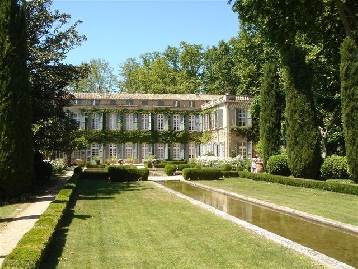
 The gardens of the Chateau de Brantes in Avignon, a late design by Mogens Tvede, for his cousin.

Long before Lee Radziwill, there was another famous Princess Radziwill, Dolly )1886-1966).  She was a patron and friend of artists, writers, and designers from Cocteau to Berard to Dior, and a major figure in International Society in the first half of the 20th century.  The portrait below, by Alex-Ceslas Rzewuski gives a hint of her stylish charms.


Prince Radziwill died in 1920, and the Princess soon remarried, to the Danish architect and painter, Mogens Tvede (1897-1977).  They lived, by all accounts, in splendor in a large town house near Les Invalides in Paris, where their circle of friends included Nancy Mitford, whose portrait was painted by Tvede. 


Although I am unable to find a great deal of information, it appears that the Tvedes were friends of the Standard Oil magnate Walter Brewster Jennings.  1927 found them as the house guests of the Jennings's at their Villa Ospo on once fashionable Jekyll Island off the Georgia coast.  As a result of that visit, Tvede was commissioned the next year to design a house there for Frank Gould, the Villa Marianna (below).


By 1930, Tvede was associated with society architect Mott Schmidt, a designer of cool, restrained and very traditional Georgian houses.  Although Schmidt loyalists protest loudly at the idea, one presumes this was a marriage of convenience, it being unlikely that Tvede had a license to practice in New York.  That year they designed a house at Cold Spring Harbor on Long Island for Oliver Jennings, son of Walter Jennings.  It is likely, given Tvede's friendship with the Jennings family, that Tvede was the lead designer on the project.  It is certainly unlike anything else Schmidt designed, a house in the modern Scandinavian neo-classical style, bold and radical, the very antithesis of Schmidt's usual work.

After traveling down a nearly mile long drive, one drove through a central arch in the garage building facing the main house across the gravel court

The entrance front of the house reminds one of the work of Emilio Terry

A two story entrance rotunda led to the drawing room

The double height drawing room was a masterpiece of modern neo-classicism.

The water front of Dark Hollow
A holy grail for this post was to find a picture of the elegant octagonal pavilion at water's edge on this estate, but it eluded me---I thought I had saved one from a real estate ad last year, but no can find.

And, just for discussion's sake, here is a photo of Dunwalke Farm, the Douglas Dillon house in New Jersey, designed by Mott Schmidt in 1936, and extremely typical of his work.  I rest my case.


Photographs of Dark Hollow, photographer uncredited, from a 1933 issue of House & Garden.  Photograph of Dunwalke Farm from Mott B. Schmidt, Architect.