15.2.11

RANDOM OBSERVATION

SUBLIME:

1959 Rolls-Royce Silver Cloud Shooting Brake, body by Radford.
(top:  Palm Beach Daily News.  lower photo: PVSBond photostream, via Flickr)
RIDICULOUS:

2000 Rolls Royce Surf Wagon, body by God knows who
 (cs.scaleautomag.com)
  
Some things have not gotten better

14.2.11

VALENTINE'S DAY DECORATIONS DOWN EAST

Mainers love to decorate for a holiday---especially by mid-winter, when everything looks drab and faded.   So, it was a pleasure when I went to the market on this gray morning  to notice how many houses on my street were decorated for Valentine's Day, and I snapped these pictures to share with you.

Two large Valentine's Wreathes on the Market set a festive mood for Valentine's day.
As do the Valentine's Wreathes decorating the handsome old houses up and down the street
My particular favorite is this elegant Valentine's garland, created by an adored friend who never met a holiday she doesn't want to decorate for

I especially like these red model dorys filled with Valentine's greenery.  I don't get the hearts in the window though.  What's that about?

 Okay, you've probably guessed by now that many of us here Down East don't rush to take down the outside Christmas decorations---though only a couple of people still have lights up.  One of those doorways might even be the Dilettante's own.  We're free spirits up here in Maine.


Happy Valentine's Day---may it be filled with love and big boxes of chocolates.


11.2.11

SIX DEGREES OF INTERIOR DECORATION

Okay, fasten your seat belts---we're off on another Six Degrees tour.

While writing a piece about menservants behaving badly in Gilded Age Bar Harbor for New York Social Diary, I mentioned Joseph Pulitzer's son-in-law, W.S. Moore, great grandson of Clement Moore of Night Before Christmas fame.  It occurred to me that Benjamin Moore (the lawyer, not the paint manufacturer), who built Chelsea, the wonderful Chinese/French house by Delano & Aldrich at Syosset Long Island, was also a descendant of Clement Moore, and I wondered how closely related the two men were.  As it turns out, very closely---they were brothers.  

 Chelsea (Nassau County Parks Dept.)


Benjamin Moore was also married to a Bar Harbor girl, Alexandra Emery, daughter of Cincinnati real estate magnate J.J. Emery, and his wife Lela, who later married the Hon. Alfred Anson, younger brother of the 4th Earl of Lichfield, who in turn was married to the niece of Elizabeth the Queen Mother---although that's not where we're going.  I'm just gratuitously inserting that information.  Royal connections always create such a nice frisson, no?

The Turrets, the J.J. Emery Cottage at Bar Harbor
The Turrets, the Emery summer cottage at Bar Harbor, is a chateauesque pile of granite designed in 1895 by Bruce Price.  Price was the father of Mrs. Price Post, better known as Emily---but that's not where I'm headed either.  Just mentioning.  Nor am I going to digress by mentioning that Bruce Price's successor partner, Jules-Henri de Sibour, architect of the French Embassy in Washington had a grandson who married a niece of Society decorator Diane Tate---but that's a different tale of six degrees of design separation--let's stick with the Emerys for awhile.  

Peterloon, the Cincinnati estate of Alexandra Moore's brother, John J. Emery Junior, was also designed by Delano and Aldrich, but in a robust early Georgian style---in strong counterpoint to his parent's Edwardian excesses.

Peterloon (Peterloon Foundation)
Emery Jr. married Irene Gibson Post, daughter of artist Charles Dana Gibson, who also had a summer home in Maine, on 700 Acre Island, near Dark Harbor.  Her aunts included Lady Astor, and her cousin was decorator Nancy Lancaster, both of whom visited often, but let's save that one for another day also, tempting though it is to wonder if Dorothy Draper or her cousin Sister Parish ever crossed paths with Lancaster at Dark Harbor. In late breaking news, we do know that Alexandra Emery, later Moore, traveled to China with Nancy Lancaster, then Tree, in 1920.  And, of course, Lancaster's first husband's brother, who was also her second husband's cousin, Marshall Field III, had a house at Dark Harbor, also...small world indeed.

The Gibson cottage, Dark Harbor, vintage postcard view
The two other Emery daughters followed a path traveled by many American heiresses before them, and married nobly---Leila second to the Duc de Talleyrand, and Audrey first (morganatically) to the Grand Duke Dimitri Pavlovich. She was later elevated to the title of Princess Romanov-Ilyinsky in her own right, not that Russian titles were worth all that much after the Revolution.  She second married Prince Dimitri Djordjadze.  After divorcing her second Prince, she resumed her maiden name and was known the rest of her life as Audrey Emery.  She finally landed, as everyone does sooner or later, in Palm Beach, where her son, Prince Paul Ilyinsky, later became mayor.  I like this thread.  Let's stick with Audrey for a minute.

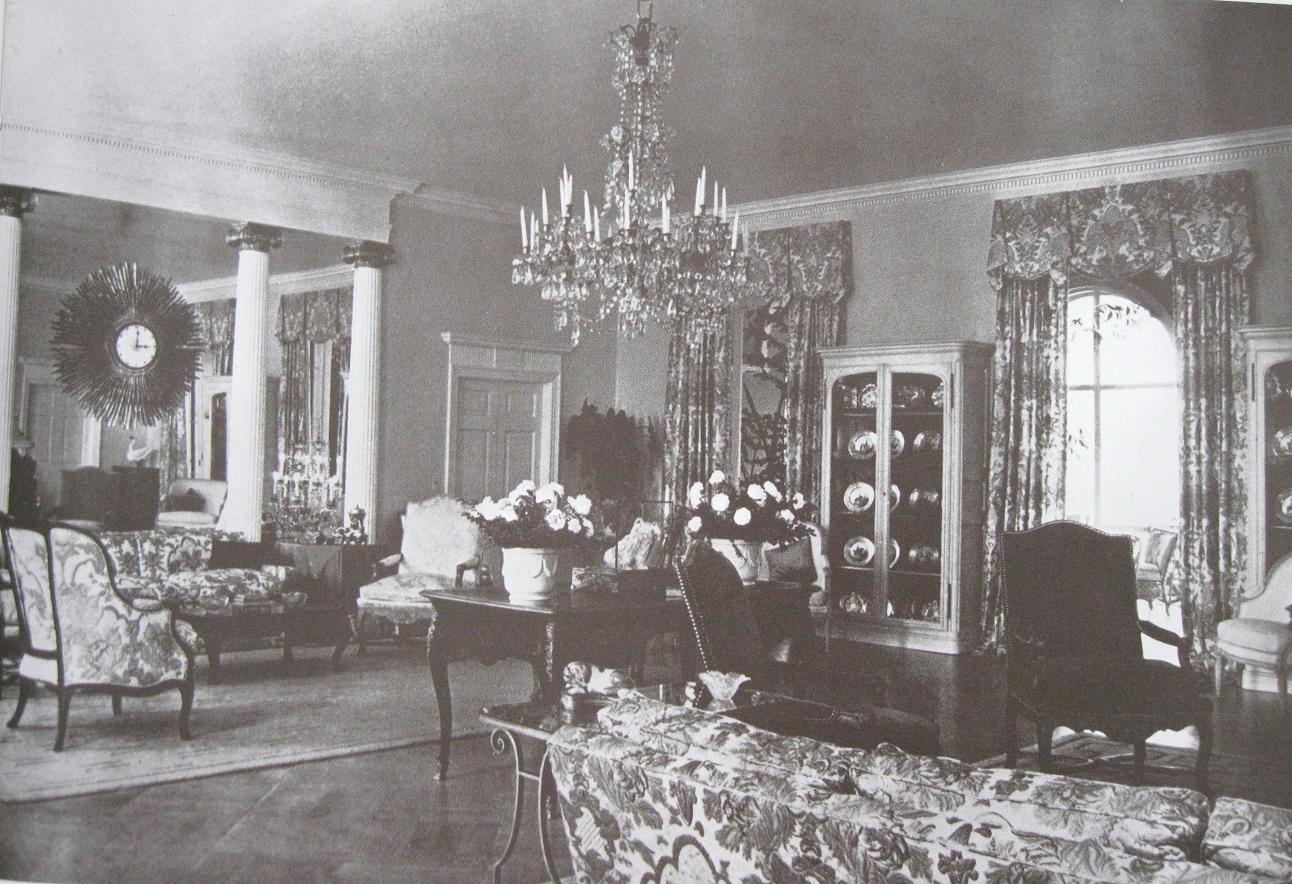
Night and Day...Audrey Emery's house on El Vedado Way, Palm Beach. The urn uplights are terrific (top: Cleveland Library Archives, bottom: Jerome Zerbe, 100 Most Beautiful Rooms)
Audrey Emery built a house on El Vedado Way in Palm Beach, designed by Clarence Mack, a stylish architect from her home state of Ohio, who had established a practice in Palm Beach specializing in elegant neo-classical houses in the style that would become known as Palm Beach Regency.  The house was much admired, and Emery's elegant drawing room was featured in a book called 100 most beautiful rooms in America---which might have been stretching it, but it was nonetheless an attractive room.


Audrey Emery's drawing room in the Palm Beach house (Zerbe, 100 Most Beautiful Rooms)
The apple doesn't fall far from the tree:  A grainy photograph of her mother's hall at The Turrets shows a Louis XV bergere and a Regence fauteuil, both very similar to chairs in the Palm Beach drawing room
Audrey Emery tended to suffer from real estate, as well as marital, restlessness, and after a few years sold her house on El Vedado.  The purchaser was Mme. Jacques Balsan, the former Duchess of Marlborough, nee Consuelo Vanderbilt, the most famous of all the nobly married heiresses.  Mme. Balsan, recently widowed, was downsizing from her enormous Casa Alva estate in Manalapan.  As for Audrey, she moved to a lovely Bermuda style house on South Ocean Boulevard, which was later owned by Jimmy Buffet.  Yes, that Jimmy Buffet.  But let's not digress.  We wouldn't want you to get confused.  Go pour a margarita and we'll continue:

A view of the Drawing Room during Mme. Balsan's occupancy, with two of four paintings of the seasons, after Lancret, Baques chandelier from Casa Alva, and Savonerrie Rug.
One misses the sunburst clock of Audrey Emery's era on the mirrored wall. (Horst photograph, Vogue's Book of Houses, Gardens, & People)
Mme. Balsan, who only a few years earlier was quoted as saying that she  only went into Palm Beach only to get her hair washed and to go to the bank, was now living in town.  Making the best of her drastically reduced quarters, she gave the house the full Vanderbilt treatment.  

A corner of the drawing room with one of the lacquer cabinets, and pair of Louis XVI chairs from the Tuileries (Horst, Vogue)
In the drawing room were her four superb Chinese lacquer cabinets on stands--the black ones between the windows of one wall, the red ones on the other.  Her magnifiicent collection of French decorative arts filled the rooms richly and gracefully, a testament to her famous taste.  The marvel of it all was that each Spring, much of the art and furniture were packed up and sent ahead to her Southampton house for the summer, then the process reversed each fall, that she might never be without her favorite things.

Mme. Balsan in the drawing room with the pair of red lacquer cabinets (Toni Frisell photograph, Life)
The drawing room of Lou Seuil, Mme. Balsan's villa on the Cote d'Azur  in the early 1930's shows one of the red lacquer cabinets, shipped to America before WWII
Shall I take it back to the Moores now, and wrap this up? Mme. Balsan's first cousin, Frederica Webb, married Edith Pulitzer Moore's brother Ralph.  They lived at Kiluna Farm on Long Island, later the home of Babe Paley, whose daughter Amanda Mortimer married Carter Burden, grandson of Mme. Balsan's cousin Florence Burden, but we'll not stray there either.  A forthright friend maintains that the rich are as inbred as any isolated island dwellers Down East.  She may be right.

Had enough?  So have I.

Well, almost enough.  I just remembered that somewhere in inventory storage, I have pretty 1920's pastel of Birch Trees by Benjamin Moore, a more than competent Sunday painter.  My parents acquired it from the estate of a former maid at The Turrets, who had accumulated many attractive cast-offs from employers in Bar Harbor over the years.  I still dream about a little apple green neoclassical urn stand from the same source.

For the New York Social Diary article that set off this ramble, Click here
For another Six Degrees Post, Click here.

9.2.11

MY DINNER WITH MARY

NOTE For those inclined to read even more Dilettante today, he can be found over at New York Social Diary, with tales of servant woes in Gilded Age Bar Harbor.  And if today's post here seems familiar, it is because it is a re-post of an earlier piece inadvertently lost.


If the title of this post, with its allusion to My Dinner With Andre, suggests to the reader an evening of sparkling conversation with a scintillating woman named Mary, you are only half right.  It was an evening with a woman Mary, but conversation did not sparkle.  This is the tale of a simple Maine boy's chilly encounter with one of the formidable literary dragons of the 20th century.


I owned a bookstore in my youth and was slightly--very slightly---acquainted with the writer and critic Mary McCarthy, who summered 20 miles away in Castine, a village so picturesque and pristine that it is sometimes somewhat competitively referred to as 'Stepford'  by residents of our own picturesque, but less pristine, community.

If I remember correctly, McCarthy was drawn to Castine by the equally formidable, but much nicer, Elizabeth Hardwick, who had in turn first visited there when her former husband, poet Robert Lowell, inherited an old house on the village green from his proper Bostonian aunt, Harriet Winslow.

One either loved McCarthy or one didn't. I was a didn't. Her fondness for her own famous intellect was more than a little off-putting, and her intellectual snobbery, worn like armor to battle, made one yearn for the simpler social affectations of a Hyacinth Bucket. Frankly, She was just not terribly nice, although her husband, a former State Department type, was a great sort.  In fairness,  I was also young, extremely shy, and though generally in thrall to the literary greats of her era, I never warmed to her writing either. Our exchanges were usually polite and brief, and she obviously got along very well without my affection.

However, in a small community, one sooner or later dines with everyone, and one evening in 1982, fate decided that it was Mary's and my turn to sit next to each other at a party. The hosts were a couple of whom I was very fond, playwright Samuel Taylor (Sabrina)--who had a more than passing resemblance to Douglas Fairbanks, Jr.--and his wife Suzanne, both of whom affected the highly stylized 1950's Hollywood/South of France glamor that one rarely sees anymore. Sam was the only person I ever knew who could actually look credible in an ascot or pull of wearing a necktie as a belt, and Suzanne was an accomplished enough hostess that Dorothy Rodgers bows to her in My Favorite Things, and  had herself published two cookbooks.


The front door of the Johnson House, Mary McCarthy's Castine home, c. 1910 postcard view
That evening I was let into the Taylor's front hall at the appointed hour (well, okay, 10 minutes past the appointed hour), and as I looked though to the terrace, I spied Mary McCarthy on a bench, holding court. With an involuntary shiver at the chilling sight, I gave a silent prayer that I would be seated at a different section of the table. Luck was not with me on that lovely summer evening. When we were summoned to the table, I was horrified to find that I was seated next to Mary.  On my right was a woman named Kay Brown, with whom I not had a chance to chat during drinks, but who I knew had been Sam's agent for many years, successfully shepherding his plays from stage to Hollywood.

At table, I tried my level darned Yankee best with Mary, who was famously disdainful of social small talk, but I might as well have tried swimming away from the Titanic. She was offering no help at all, absolutely none, and all my attempts were sinking. Flattery? I happened to be reading her Stones of Venice at the time, and enjoying it. Nope. I'd been on an Edmund Wilson kick the year before, but certainly she wouldn't be pleased to be reminded of what her former husband had written about her, so I didn't go there, though tempted. An article from from the latest New York Review by her friend Elizabeth Hardwick? "No, I haven't read that yet". Thud. An article she'd written about Alice Brayton, creator of Green Animals near Newport--perhaps we can find some mutual ground in a conversation about taste? Nope. Okay, small talk it is: Isn't this Vichyssoise delicious? Please! I'm going down for the third time, and this cold but supposedly witty woman is not tossing me a life preserver. At that moment, it was time to turn right, to Kay Brown, and suddenly I felt the warm relief a storm tossed passenger feels at reaching the balmy tropical isle. She was alive, interested, and ready to find out more about the poor young guy next to her, still shivering from his encounter with the iceberg. It turned out that she had not only been my host's agent, but that it was she who had brought Gone With the Wind to David Selznick's attention, and after her visit here, she was on her way to Japan on behalf of the Mitchell estate to discuss the rights to a Japanese musical version of GWTW.  Finally!  Some material I can work with!---and we were off and running. All too soon, I had to return to the iceberg on my left, and once again the cold winds of Siberia blew in my face. And so it went, until dessert, a delicious ginger mousse which I remember fondly 30 years later, and which memory lessens the shock that I am now probably the only person alive who was at that party...


After dinner, Mary and I were in separate groups, at least one of us relieved not to have to be trying with the other any more. At the end of the evening, saying good nights, I felt my good manners drain from me, and I turned to the literary gorgon, who was ignoring my departure, held out my hand, and with all the elaborately gracious sarcasm I could muster,  said 'Good night Mary, I'm sooo sorry we didn't get to chat more" (hey, I never claimed to be Oscar Wilde--or even Oscar Levant). Bad move. She just looked up at me, Medusa like, bared her little gray teeth into a semblance of a snarl---I  mean, smile---and slowly and carefully said "Oh, I too", and narrowing her eyes into slits, repeated "I too", abruptly pulling away her hand and turning back to her conversation. Moral: amateurs should be careful of sparring with the pros. And off into the night I went. I can still see her, sitting in that lovely room, her famous and faded looks lit by lamplight, as always pleased with herself beyond what the evidence justified. 

But wait! There's more! McCarthy was at the time being famously sued by Lillian Hellman, having said on the Dick Cavett Show that Hellman was the most overrated writer in America, and that every word she wrote was a lie including 'and' and 'the'. That I knew. What I didn't know, but that my charming but sometimes wicked hostess did, was that she had seated me between not just her husband's agent and Mary McCarthy, but between Lillian Hellman's former agent and Mary McCarthy.  Um, thanks.

And that children, is the tale of the night that your uncle Dilettante jousted with Mary McCarthy and lost.
 
PS.  As this is really a blog about New England design and architecture, and not about dropping the names of people famous half a century ago, here are a few shots of Mary McCarthy's house in Castine.  Inspired by the Asher Benjamin plate that heads this blog, naively interpreted by a local carpenter, it was built for Daniel Johnson just after 1800 

Ah, Polaroids! What we antique dealers used before the digital camera. A faux painted stereo cabinet made in Paris for McCarthy in the 1960's. The right hand front dropped down for the receiver, and the top slid to access the turntable (remember turntables?). The Dilettante purchased this for himself, along with the original cabinetmaker's drawings, but being an antiques dealer, sold it. And is still rather sorry. 


NOTE:  Please visit this link for images by Susan Wood of Mary McCarthy at home in Castine, looking surprisingly benign.
 

4.2.11

PROVENANCE: MOURNING BECOMES THE DILETTANTE.

As regular readers of this blog know, my aesthetic tastes are all over the map.  I'm easily seduced---the gentle New England charms of Hamilton House, A Marin watercolor, a Holbein portrait, the modern wonders of Fortune Rock, a Moroccan garden, a Franz Kline, a Murano candlestick---all call to me as surely as a siren song lures a sailor

No matter how diverse or worldly my taste has become, a little corner of my heart forever belongs to the world I knew and loved best growing up---the austere and optimistic elegance of Federal New England.


The watercolor above, The Hurlburt Family Mourning Piece, was painted in Connecticut in 1808 by Sarah Hurlburt, using techniques that she doubtless learned in a young ladies seminary.  I love the composition, with the strong shapes of the mourners in their hats and bonnets flanking the elegant monuments of departed relatives.  The palette of fresh green and black emphasizes the details---this is the style of early New England as I loved it.

The New England sensibility evoked by this painting aside, it is even more personal for me, as it  hung in my childhood bedroom.  Our parents encouraged my sister and me to choose paintings from their collection for our rooms.   My sister, as befitted a horse-mad adolescent girl, chose an early 20th century horse portrait, and two sporting prints that also featured horses.  These co-existed in her room with posters of Davy Jones and the Monkees, and a pen and ink drawing copied from Aubrey Beardsley, drawn by yours truly---but that's a different story. 

My first choice was a Gilbert Gaul of two boys on a dock, very Eakins in composition and palette, a crisp painting utterly unlike the genre work for which Gaul is better known.  That request was denied, as it was my parent's favorite painting, and probably most valuable of their modest collection, and it remained where it was, at the far end of the living room.  But my mother more than cheerfully parted with the mourning picture, which had hung in the dining room, and a charming Barbizon school painting by Troyon---the usual rural French scene  with sheep and a church and sunset in the distance.   Yes, I was an odd child, with odd tastes, I admit it.  Not for me the usual posters of Cars and baseball players.   These joined a Beaux Arts style architectural drawing I'd bought with my allowance at an estate sale, and which still hangs in my sitting room 45 years later.

As for the mourning picture, it is an object lesson in how pieces travel through the marketplace  My parents bought it in 1964 from a noted Maine artist, Francis Hamabe.  He had acquired it a woman in Bangor who used it as partial payment for one of Hamabe's works.  How she happened to have it is lost to history.  When we owned it, it was frame dwith a modern white  mat.  I can still remember every detail of that picture---the crackled horse glue remaining on the border from a previous mat, with the ink signature of the artist visible underneath---and the texture and iridescence of the stippled dots of rich green gouache that delineated the rippling grass in the foreground

In 1973, I sold the picture, if memory serves me correctly, for $1800.00 .  It seemed a lot of money at the time.  Gosh knows what I did with the money---a car?  a trip to Europe?  Dinners out?  All of the above?  Probably.  You know what they say about a Dilettante and his money...

The painting was purchased by Calista Sterling, who was THE fashionable antiques dealer of our region in that era ( a position the Dilettante would later occupy in his turn in the 1990's).  She sold it in time to Joe and Hazel Marcus, retired textile manufacturers, collectors of Americana, who in their retirement ran a well known business called The Ebenezer Alden House.  Then the trail runs cold for awhile, until 1987, when to my great surprise, I opened  the new issue Architectural Digest (I still subscribed in those days), and in an article about American Folk Art, was the Hurlburt Memorial.  it was in possession of David Schorsh, a dealer both famous and notorious.The simple white mat was gone, replaced by an appropriate and fancy black and gold eglomise mat.  It was interesting to see it pictured there, and of course caused a pang of regret, for the $1800 dollars was long gone in support of youthful extravagance, and now the painting was worth far more.  I closed the magazine, and didn't think of the painting again, until for some reason it crossed my mind the other day.  

I typed 'Hurlburt Memorial' into Google, and to my surprise, there it was, now in the collection of the Museum of American Folk Art in New York, and considered perhaps the finest of its genre.  Exhibited earlier this year in the exhibit, WOMEN ONLY: FOLK ART BY FEMALE HANDS, the catalog notes tell the rest of the story:

Young women of the upper classes received art instruction at such schools as Sarah Pierce's Female Academy in Litchfield, Conn. There, they learned to do watercolor landscapes in the fashionable pastoral style. This gentle view of nature was extended into another popular form of the early 19th century – the memorial painting. These employed various symbols of death and mourning, including the weeping willow and the obelisk, from Egyptian art. You can see more Egyptian influence in the 1808 memorial work by Sarah Hurlburt, with its four bonneted women lined up in nearly identical flat profiles.

3.2.11

WE INTERRUPT OUR REGULARLY SCHEDULED PROGRAM...

...TO BRING YOU THE NEWS

Although we are having a rare day of full sunshine, the weather forecast has been, and remains for the foreseeable future, snow, snow, and more snow. Although there have been really a lot of storms, even by Maine standards, one can't fairly complain, because it turns out that all of you are suffering from snow---except for the folks down in Florida, and we don't want to hear any whining about a few chilly evenings.  It has been genuinely epic up here.  Yesterday, as 15 more inches got dumped on us in back to back storms lasting 36 hours, only the post office and two grocery stores were open---the rest of the village was shut down.


This is a view of the meadow behind my house, taken a few minutes ago.  Don't be deceived by the sunshine.  We've been having more than a foot a week of this white stuff.  Even with melt and settling, there are fully three feet of it on the ground.  In the background can be seen Blue Hill Mountain, which is really a hill, 78 feet shy of the official 1,000 feet required to make it a mountain.  Over the years, a few enterprising souls have erected rock piles to try to gain those few feet, but they tend not to finish.  Piling up 78 feet of rocks is a lot harder than it sounds.  In the foreground can be seen Dilettante mountain, the 6 foot high snow pile at the end of the driveway.  This name is to distinguish it from the six foot piles of snow at the entrance to the driveway, which are connected to this one by a smaller range of 4-5 foot snowbanks along the length of the drive.  I think of these mini-mountain range as my own personal Alps. The driveway definitely feels like a snow Mountain pass.  I know some of you will be tempted to say how pretty it is.  Save it.  Uh-uh.  Don't want to hear it.  Nope. 


Just to make myself even more miserable, here is the same view, alive with buttercups, in late May of last year.  This is how the world is supposed to be...

And how do we cope with all this snow?  Who says we do?  I, for example, while stocking up on supplies, spotted a package of Betty Crocker peanut butter cookie mix.  And I bought it.  And I baked them.  And I ate them.  This is not the type of thing I'd usually do.  Oh No.  Not I ...I'd make them from scratch...


EDITORIAL PAGE:  I pretty much live for Thursdays and Saturdays, when Gail Collins appears on the Op-Ed page of the New York Times.  She manages to skewer the stupider moments in American politics---a wide open field these days---and she takes out her targets with lancer wit and surgical precision.  I recommend her take on the snow situation in today's paper.  That is I recommend it unless you aren't a left leaning commie pinko effete liberal like me, and/or  you have no sense of humor.  Then you might be offended.  Click HERE.   And as long as you're in The Times, check out the really great story about Margaret Russell's overhaul (long needed) of Architectural Digest, and the current state of shelter magazines, without which the Dilettante could not survive, HERE


LATE BREAKING NEWS FROM A ONCE-GREAT PAPER:  The Washington Post, the paper that brought us the Pentagon Papers, is perhaps not the news source it once was.  This week's Home section's lead story is that Pantone has announced it's color of the year, 'Honeysuckle', which many of us would call 'Pink'.  This news is two or three months old, having been covered by practically every design blogger and newspaper style section back when Pantone first announced it (replacing last year's Tiffany Box Blue, whose Pantone name I've already forgotten).  Way to go, Washington Post.  But, speaking of pink, that allows me to gratuitously insert this clip of marvelous Kay Thompson, author of the Eloise books, in Funny Face, when her fashion editor character decreed that Pink was the new color.


AND IN OTHER NEWS:  For those of you who haven't heard, as surprisingly neither the Times nor the Post covered the story, the Dilettante can now be read in New York Social Diary.  Thanks to all of you--and a special shout out to you, Little Augury--for all the kind words and compliments.  I am most grateful to DPC for this adventure, and to JH for making my words and pictures look so good.  More to come!

Beginning in April, I can also be read in Portland Monthly, as their new Antiques Marketwatch columnist.  Also, in their next issue, I will have an article about a bold mid-century design and art venture started up here in 1950---how mid-century can you get?---by the mother of architect Ben Thompson.  

And that's all I've got today.  There's  a snow shovel and yet more aerobic exercise waiting for me at the store.  Fortunately, the cookies are all gone.

1.2.11

ANNALS OF TASTE: A Garage in Palm Beach.

Taste is always a tricky topic---subjective, and relative.  As regular readers know, it is a subject that endlessly fascinates me--when should one be wild, when should one leave well enough alone, when do you break the rules, when do you follow them?   Well, as I said, it's subjective.  Years ago, when I was misspending some of my misspent youth in Palm Beach, this was a house that I particularly admired.  While it might not give the Via Mizner competition, I thought it was one of the most interesting new houses on the island  I'm sorry now that I didn't take many more pictures when I had the opportunity.  I used .to be very restrained with my camera.  Unlike with my opinions.

The house is on an in-town lot, maybe three hundred feet from the ocean in the shadow of a giant condominium complex on South Ocean Blvd..  It flew in the face of the prevailing Palm Beach aesthetic of high show and pastel painted stucco.  It was original, and it was brave.


 This garage is all one sees from the street---the smallish house is entered from the side, and runs shotgun to a living room and loggia overlooking a pool.  Although the design inspiration was Italian----mutual friends told me that the then owner had modeled this garage at the front of the house, with its orange and black chevron patterned door and sundial set in a pediment, after similar features on his villa in Italy.   The stucco, stained, not painted, a deeply pigmented red, was so right in the tropical light, and so rich of surface that it made a mockery of all its larger, more ambitious and more ordinary pastel neighbors.  Within the courtyard, one might as well have been in Tangier.


Nowadays the house has different owners.  The garage door is white, the tinted tucco a covered with flat lifeless coat of peaches and cream paint.   As happens so often, conventional and ordinary have won.  People are so afraid.