Showing posts with label Pulitzer. Show all posts

11.2.11

SIX DEGREES OF INTERIOR DECORATION

Okay, fasten your seat belts---we're off on another Six Degrees tour.

While writing a piece about menservants behaving badly in Gilded Age Bar Harbor for New York Social Diary, I mentioned Joseph Pulitzer's son-in-law, W.S. Moore, great grandson of Clement Moore of Night Before Christmas fame.  It occurred to me that Benjamin Moore (the lawyer, not the paint manufacturer), who built Chelsea, the wonderful Chinese/French house by Delano & Aldrich at Syosset Long Island, was also a descendant of Clement Moore, and I wondered how closely related the two men were.  As it turns out, very closely---they were brothers.  

 Chelsea (Nassau County Parks Dept.)


Benjamin Moore was also married to a Bar Harbor girl, Alexandra Emery, daughter of Cincinnati real estate magnate J.J. Emery, and his wife Lela, who later married the Hon. Alfred Anson, younger brother of the 4th Earl of Lichfield, who in turn was married to the niece of Elizabeth the Queen Mother---although that's not where we're going.  I'm just gratuitously inserting that information.  Royal connections always create such a nice frisson, no?

The Turrets, the J.J. Emery Cottage at Bar Harbor
The Turrets, the Emery summer cottage at Bar Harbor, is a chateauesque pile of granite designed in 1895 by Bruce Price.  Price was the father of Mrs. Price Post, better known as Emily---but that's not where I'm headed either.  Just mentioning.  Nor am I going to digress by mentioning that Bruce Price's successor partner, Jules-Henri de Sibour, architect of the French Embassy in Washington had a grandson who married a niece of Society decorator Diane Tate---but that's a different tale of six degrees of design separation--let's stick with the Emerys for awhile.  

Peterloon, the Cincinnati estate of Alexandra Moore's brother, John J. Emery Junior, was also designed by Delano and Aldrich, but in a robust early Georgian style---in strong counterpoint to his parent's Edwardian excesses.

Peterloon (Peterloon Foundation)
Emery Jr. married Irene Gibson Post, daughter of artist Charles Dana Gibson, who also had a summer home in Maine, on 700 Acre Island, near Dark Harbor.  Her aunts included Lady Astor, and her cousin was decorator Nancy Lancaster, both of whom visited often, but let's save that one for another day also, tempting though it is to wonder if Dorothy Draper or her cousin Sister Parish ever crossed paths with Lancaster at Dark Harbor. In late breaking news, we do know that Alexandra Emery, later Moore, traveled to China with Nancy Lancaster, then Tree, in 1920.  And, of course, Lancaster's first husband's brother, who was also her second husband's cousin, Marshall Field III, had a house at Dark Harbor, also...small world indeed.

The Gibson cottage, Dark Harbor, vintage postcard view
The two other Emery daughters followed a path traveled by many American heiresses before them, and married nobly---Leila second to the Duc de Talleyrand, and Audrey first (morganatically) to the Grand Duke Dimitri Pavlovich. She was later elevated to the title of Princess Romanov-Ilyinsky in her own right, not that Russian titles were worth all that much after the Revolution.  She second married Prince Dimitri Djordjadze.  After divorcing her second Prince, she resumed her maiden name and was known the rest of her life as Audrey Emery.  She finally landed, as everyone does sooner or later, in Palm Beach, where her son, Prince Paul Ilyinsky, later became mayor.  I like this thread.  Let's stick with Audrey for a minute.

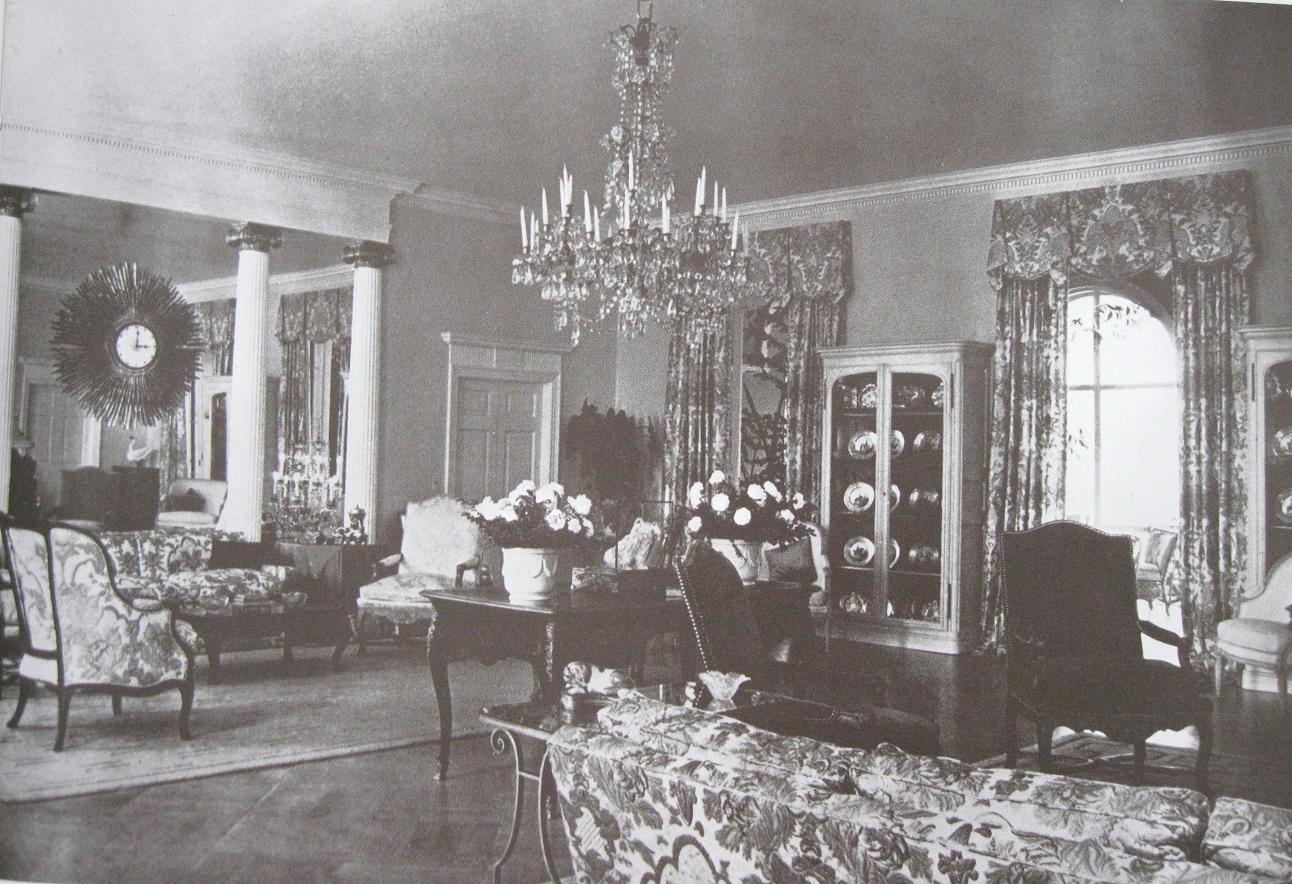
Night and Day...Audrey Emery's house on El Vedado Way, Palm Beach. The urn uplights are terrific (top: Cleveland Library Archives, bottom: Jerome Zerbe, 100 Most Beautiful Rooms)
Audrey Emery built a house on El Vedado Way in Palm Beach, designed by Clarence Mack, a stylish architect from her home state of Ohio, who had established a practice in Palm Beach specializing in elegant neo-classical houses in the style that would become known as Palm Beach Regency.  The house was much admired, and Emery's elegant drawing room was featured in a book called 100 most beautiful rooms in America---which might have been stretching it, but it was nonetheless an attractive room.


Audrey Emery's drawing room in the Palm Beach house (Zerbe, 100 Most Beautiful Rooms)
The apple doesn't fall far from the tree:  A grainy photograph of her mother's hall at The Turrets shows a Louis XV bergere and a Regence fauteuil, both very similar to chairs in the Palm Beach drawing room
Audrey Emery tended to suffer from real estate, as well as marital, restlessness, and after a few years sold her house on El Vedado.  The purchaser was Mme. Jacques Balsan, the former Duchess of Marlborough, nee Consuelo Vanderbilt, the most famous of all the nobly married heiresses.  Mme. Balsan, recently widowed, was downsizing from her enormous Casa Alva estate in Manalapan.  As for Audrey, she moved to a lovely Bermuda style house on South Ocean Boulevard, which was later owned by Jimmy Buffet.  Yes, that Jimmy Buffet.  But let's not digress.  We wouldn't want you to get confused.  Go pour a margarita and we'll continue:

A view of the Drawing Room during Mme. Balsan's occupancy, with two of four paintings of the seasons, after Lancret, Baques chandelier from Casa Alva, and Savonerrie Rug.
One misses the sunburst clock of Audrey Emery's era on the mirrored wall. (Horst photograph, Vogue's Book of Houses, Gardens, & People)
Mme. Balsan, who only a few years earlier was quoted as saying that she  only went into Palm Beach only to get her hair washed and to go to the bank, was now living in town.  Making the best of her drastically reduced quarters, she gave the house the full Vanderbilt treatment.  

A corner of the drawing room with one of the lacquer cabinets, and pair of Louis XVI chairs from the Tuileries (Horst, Vogue)
In the drawing room were her four superb Chinese lacquer cabinets on stands--the black ones between the windows of one wall, the red ones on the other.  Her magnifiicent collection of French decorative arts filled the rooms richly and gracefully, a testament to her famous taste.  The marvel of it all was that each Spring, much of the art and furniture were packed up and sent ahead to her Southampton house for the summer, then the process reversed each fall, that she might never be without her favorite things.

Mme. Balsan in the drawing room with the pair of red lacquer cabinets (Toni Frisell photograph, Life)
The drawing room of Lou Seuil, Mme. Balsan's villa on the Cote d'Azur  in the early 1930's shows one of the red lacquer cabinets, shipped to America before WWII
Shall I take it back to the Moores now, and wrap this up? Mme. Balsan's first cousin, Frederica Webb, married Edith Pulitzer Moore's brother Ralph.  They lived at Kiluna Farm on Long Island, later the home of Babe Paley, whose daughter Amanda Mortimer married Carter Burden, grandson of Mme. Balsan's cousin Florence Burden, but we'll not stray there either.  A forthright friend maintains that the rich are as inbred as any isolated island dwellers Down East.  She may be right.

Had enough?  So have I.

Well, almost enough.  I just remembered that somewhere in inventory storage, I have pretty 1920's pastel of Birch Trees by Benjamin Moore, a more than competent Sunday painter.  My parents acquired it from the estate of a former maid at The Turrets, who had accumulated many attractive cast-offs from employers in Bar Harbor over the years.  I still dream about a little apple green neoclassical urn stand from the same source.

For the New York Social Diary article that set off this ramble, Click here
For another Six Degrees Post, Click here.

13.4.10

Pulitzer Prize: Chatwold

Today's announcement of this year's Pulitzer Prizes reminded me that the events that led to the creation of the prize were set in motion here in Down East Maine in 1902.

 Chatwold, Entrance front from Sheldon's Artistic Country Seats

In 1893, Joseph Pulitzer, arguably the most powerful newspaper publisher in America, and his wife, Kate Davis, cousin of Confederate President Jefferson Davis, came to Bar Harbor for the summer, renting the Louise Bowler Livingston estate, spectacularly located on a cove off Ocean Drive south of town.  


Views of Chatwold from American Architect & Building News,  1882

The estate, known as Chatwold, had been designed for Mrs. Livingston, when she was Miss Bowler, in 1884 by the prominent Boston architects Rotch and Tilden.  Much admired, it was published in many of the foremost architectural publications of the day, including George Sheldon's Artistic Country Seats.  Of stucco and half timber construction over a first floor trimmed in the local pink granite, the turreted affair consisted of 27 rooms and an astonishing 7 bathrooms on its three main floors.  The Pulitzers liked the property, and bought the estate from Mrs. Livingston the next summer.

Fireplace alcove under stairs.  American Architect

Pulitzer suffered from a nervous disorder and blindness, and was extremely sensitive to sound.  He was said to be happiest on water, especially on his 267 foot steam yacht, the Liberty, which was kept anchored and ready offshore.  To achieve ideal quiet on land, McKim, Mead & White were summoned from New York to design an addition with special soundproof bedroom for Pulitzer.   And what an addition it was---connected to the main house by a new wing, it was a huge stone tower, forty feet square, four stories high.  At basement level, there was an indoor pool, ocean fed and steam heated.  On the main floor, there was a dining room, and a huge paneled library.

Two views of the ocean front, showing Tower of Silence

Above on the next two floors were offices and bedrooms for Pulitzer's secretaries (who were said to dread their working summers with their driven employer).  At the top of the tower was Pulitzer's bedroom---with a floor on ball bearings, double glazed windows, and walls insulated with steel wool.  The completed structure was dubbed the 'Tower of Silence' by family and staff.  A new stable, with stalls for 26 horses and extensive servant's quarters was built, along with enlarged greenhouses to keep the house in fresh flowers and fruits.

Entrance front, American Architect & Building News, 1883
Entrance Front after additions of Tower of Silence (left), and new service wings (right)

Despite his paper's editorial stance on wealth, Pulitzer himself had no trouble adapting to the luxurious life at Bar Harbor.  Summers passed, with yachting parties, tutors and dances for the children, daily horseback rides with his secretaries, and yet another enlargement of Chatwold.  Andrews, Jaques & Rantoul, a Boston firm with a large Bar Harbor practice (Herbert Jaques had a summer house just down the road at Schooner Head) were summoned, and the servant's wing  was nearly tripled in size, and yet another stone tower added.  A critic at the time said the whole had come to resemble a Norman village.  With over 50 rooms, Chatwold was now one of the largest houses in a town of very large houses.

In the summer of 1902, seized with a new idea, Pulitzer summoned his secretaries, and in the library at Chatwold dictated an outline of this idea---for a school of journalism at Columbia University, which would also administer a prize for journalistic excellence, which eventually became the Pulitzer Prize.

Pulitzer died aboard his yacht en route to his winter home on Jekyll Island, Georgia in 1911. The next year, the new Columbia School of Journalism was opened, and in 1917, the first Pulitzer prizes were awarded.

Pulitzer's yacht, the Liberty

By 1925, Mrs. Pulitzer found the responsibility of maintaining the estate too burdensome, and retired to her chateau at Deauville, leasing the cottage to her son, Joseph Pulitzer II, for $2,500.  Two years later, upon her death, he assumed ownership of the estate.  Guy Lowell, architect of the Museum of Fine Arts in Boston, was brought in to make updates and alterations to the house.  Life continued on much as before until the stock market crash of 1929.  The  John Singer Sargent portrait of Kate Davis Pulitzer was still shipped to Bar Harbor each summer to hang in the dining room, which had acquired new murals of the Bay of Naples.  A chauffeur still drove the sleek gray 'country' Packard.  But, though still a wealthy man, Pulitzer felt the pinch and tried to economize where he might.  Among his cost cutting measures was reducing Gardenia operations in the greenhouse---no longer would each breakfast tray have a fresh gardenia every morning, only those of Mrs. Pulitzer and special guests---"the children won't really miss them".   Nevertheless, hothouse melons were still grown for the table, and a Swiss chef, several gardeners, a butler and a bevy of maids continued to be employed, at reduced wages, and somehow the family muddled through.

The music room, attached to the greenhouses.

The end was near, however.  Chatwold wasn't opened in the summer of 1932, and in 1936, the Tower of Silence was taken down.  In 1938, the Pulitzers rented a smaller cottage nearby, although they found the net saving was only $2,000.  Chatwold was placed on the market for $225,000, but with the effects of the depression still being felt, and war on the horizon, there were no takers.   A lavish wedding for daughter Kate  in 1941 was the last big party at Chatwold, with several hundred guests dancing to an orchestra on the terrace.  In 1945,  after writing a friend that "the day of the summer palace is over", Joseph Pulitzer II had Chatwold,  the greenhouses, and all outbuildings except the huge garage demolished.  He had planned to build a new house on the site, but instead purchased a relatively smaller cottage, Beachcroft, closer to town, and remodeled it, incorporating salvage from Chatwold.  Other choice bits--mantels, doors, paneling and art, were stored in the garage for future use .  In 1947, a forest fire swept Bar Harbor, destroying the garage and the stored fragments of Chatwold, and were it still standing, Chatwold itself would also have gone up in flames.  The day of the summer palace was indeed over.

 For a tale of the servant problem at Chatwold, read a story by the Dilettante in New York Social Diary by clicking HERE

27.2.10

Have Boiserie Will Travel, Before, After, and After


The drawing room of a friend's apartment in the Pulitzer mansion, as decorated for him by Natalie Davenport of McMillen, Inc. in the 1960's
 I continue to rummage through my old clip files, revisiting favorite sites, remembering old friends.  Yesterday, I found one about a singular apartment in New York's Pulitzer mansion, created by a kind friend many years ago.

While at Yale, he had considered studying architecture, but felt he lacked the math--- he was passionate about houses and decoration---as well as music, but that is outside the scope of this post.   Throughout his lifetime, he made many contractors, real estate brokers, architects and decorators very happy.  I believe that there were over 30 houses and apartments over the years, usually two at a time.  The decorating firm of McMillen alone handled 17 commissions for him.  There were at least five by the brilliant modernist master Ben Baldwin.
 
Main Hall of the Hoyt cottage in Southampton
He had been brought up in grand surroundings.  In summer, his parents occupied the palatially scaled former  Hoyt estate in Southampton,  Winters vacations were spent in Palm Beach.  His father, to make work for the unemployed during the depression, had bought the Tiffany Mansion on Madison Avenue, and demolished it in favor of an elegant apartment building, the first built in New York since the crash of '29, and and also considered the last great  pre-war building.  The architects were Rosario Candela and Mott Schmidt, and the family occupied a 21 room duplex on the top floors.  It was during this process that his passion for his surroundings were formed.

After his parents died, he inherited a large collection of fine English portraits and Georgian furniture typical of the rich Anglophiliiac taste of the day.  The collection, even after division with two siblings, amply furnished his apartments in New York, including a handsome duplex on Fifth Avenue just downstairs from a young couple named Von Bulow.
His parent's Romney portrait, as seen in the dining room of his former wife's apartment on Park Avenue, also by McMillen
After a divorce, his parent's Gainsboroughs, Romneys and Raeburns went to his former wife's apartment on Park Avenue, and our friend, giving outlet  to his taste for something French, bought an apartment  formed from the former soundproofed bedroom suite of Joseph Pulitzer, on the second floor of the publisher's former mansion by McKim, Mead, & White on East 73rd St.  Measuring 26 x 36, the beautifully proportioned main room was what particularly caught our friend's eye, large enough for his Boesendorfer grand, and for entertaining for the various good causes he supported.
 The mezzanine bedroom in the Pulitzer house apartment, as done for our friend by McMillen (top), and for the next owner by Denning & Fourcade (bottom)
Finding the McKim, Mead and White interior not to his taste, he commissioned his decorator, Natalie Davenport of McMillen, to find an 18th century boiserie in France.  Once located, it was brought to this country, along with French craftsman to install it.  Then the fun of furnishing began.  These rooms were as far from the age of Aquarius, then dawning,  as the best upholsterers and painters in New York could make them. When finished, it was the ne plus ultra of the rich taste of the era, recalling the apartment, also by McMillen, for the Henry Fords, and the Wrightsman rooms at the Metropolitan Museum, which were then being decorated by Jansen of Paris, who also supplied many of the modern furnishing pieces used in this commission.
The lacquer bed (from McMillen Website)
 The octagon room, as decorated for our friend by McMillen, above,
and Denning and Fourcade's version for the new owner, below
The octagonal room was hung with silk of an indescribable shade of pale peach, and was centered on the most extraordinary lacquered bed imaginable, supposedly made for the Brighton Pavilion, an attribution shared with almost all Chinoiserie furniture of the early 19th century.
His parent's Romney, as seen two or three moves later in our friend's new apartment by Benjamin Baldwin
Needless to say, our friend grew architecturally restless, leaving the Pulitzer apartment for awhile, trying out two modern apartments on 5th Avenue, a summer house in Connecticut, another in Maine, a small chateau in France, then moved back to the Pulitzer House apartment which he'd kept through it all.  He then resolutely switched to modern, eventually winding up in a sublimely reductionist apartment nearby, with interiors not by McMillen, but by modernist master Benjamin Baldwin.  Here, after his former wife's death, his parent's English portraits also came to roost.
The library of the new apartment.  Two more moves later, the Cleve Gray was taken to a new summer house in Maine.
The story of the Louis XVI drawing room doesn't end here, however, nor does that of the bed.  The Pulitzer house apartment changed hands, and the new owner, also a philanthropist and arts patron, desiring something cosier, brought in Denning and Fourcade, who brought in  their signature mix of densely patterned rich fabrics, and, while keeping the McMillen curtains, refashioned it as an interior in Le Style Rothschild, redolent of the fin de siecle.  The former bedroom, now a dining room, was a particular horror.

The Drawing Room, McMillen version
New owner, same old curtains--the Pulitzer House drawing room in its Denning & Fourcade drag.
After a few years, the new owner wearied of this heavy opulence (I myself would last about 3.2 seconds in a Denning & Fourcade interior before I'd have to be taken, screaming,  to a monastic retreat to sooth my shattered nerves).  In 1986, Patrick Naggar was called in, degilded the boisierie, hung new  curtains, and gave the room a luxe French Moderne touch.
 
 
The drawing room, in its post Denning and Fourcade mode. The chandelier remains the same
As for the Prince Regent's lacquer bed, it followed our friend, sans canopy due to lower ceilings, to  a country house in Connecticut, and another apartment on Fifth Avenue, before being sold to another royal, Mario Buatta, the Prince of Chintz, who I believe sleeps in it to this day.

 Mario Buatta, at work in the lacquer bed, de-accessioned by our friend.

Illustrations:  
All McMillen photos, from 'The Finest Rooms by America's Great Decorators'
Denning & Fourcade and Patrick Naggar Drawing room photos, Edgar De Eviva & Lizzie Himmel, New York Times Magazine, January 31st, 1988
Denning & Fourcade Bedroom and Dining Room, New York Magazine, n.d.
Mario Buatta Bed Sketch, Konstantin Kakanias for the New York Times.
Baldwin decorated apartment, Architectural Digest by Peter Vitale, September 1979.
Hoyt Villa Hall, Architectural Review