17.12.10

"The Riviera, Where Every Golden Coat of Sun Tan

...has cost the gold of more than one man..."

The calendar says late fall, but a  look out my windows says winter.  With darkness arriving by 4:00 PM, one is very glad for Netflix---where I can dig deep into the archives of forgotten films and sometimes come up with gold, streamed to my laptop even as I check email.  Amongst the movies I've viewed lately, a theme has emerged (and one knows how the Dilettante loves a theme--bring on the coincidence!)

It started with 'Encore', a collection based on short stories by Somerset Maugham, the writer whose reputation in the design world is eclipsed by having been the ex-husband of decorator Syrie.  Each story is introduced by Maugham himself, and one of the treats is that these narrations are filmed in the garden of his home, Villa Mauresque at Cap Ferrat, almost overshadowing Glynis Johns' performance as a high diver who loses her nerve while performing at Monte Carlo.  The decadent Maugham bought La Mauresque in 1928, and like so many houses of the socially ambitious before him, it became his calling card into Society, with invitations coveted even by those who disdained him. Crime writer E. Phillips Oppenheim wrote, ‘Everyone on the Riviera accepts an invitation from Maugham at any time they are lucky enough to receive it’

 Screen caps of Somerset Maugham and his garden at La Mauresque from 'Encore'

Two movies later, I found myself back on the Riviera with "Love is a Ball", starring Glenn Ford, Hope Lange, and Charles Boyer.  A plodding romantic comedy, the movie was filmed on location, and although Boyer does his best as a sophisticated matchmaker for money, the real star of this movie is its location---Ogden Codman's villa La Leopolda at Villefranche-Sur-Mer.

Charles Boyer, as Mr. Pimm, arrives with entourage and realtor at 'La Leopolda' in "Love is a Ball"

Everyone interested in design history knows the story of Codman, I'll try to do the briefest of recaps---a highly refined soul, he grew up in an aristocratic Boston family.  When his father suffered financial reverses, the family removed themselves to Europe, where Codman's aesthetics took shape.  He became a designer/architect, and collaborated with Edith Wharton, on the groundbreaking The Decoration of Houses, the book that blew the knick knacks of Victorian America right off the what-not shelves, and ushered in an era of delicate French style that was to define rich taste for the next half century.   From Wharton came Codman's big break, the decoration of the private quarters of Cornelius Vanderbilt's 'The Breakers' at Newport.   From there, he went on to collaborate with Elsie de Wolfe, and became one of Society's favorite architect/decorators, creating delicately detailed houses for the haute monde from New York to Newport.

They inspect the terrace and the view, where the realtor warns them that the rent is "very expensive---7,500,000 francs a month"

In middle age, to everyone's surprise, 'confirmed bachelor' Codman married the wealthy widow Leila Griwold Webb, six years his senior.  After her death a few years later, he found himself rich, and getting richer by the day on the inflated stock market of the 1920's.  He decided he could retire, and casting aside the vulgarity of America, so unpleasant to his delicate sensibilities, he removed himself to France, where he bought the spectacular property of King Leopold of the Belgians, and began construction on his dream house, 'La Leopolda', the distillation of all his design theories, and intended to be the finest house on the Riviera.

  Boyer & Company inspect the kitchen, and walk through the empty main floor

 After hubris comes a fall, and the Depression hobbled Codman's finances.  Forced to rent out 'La Leopolda', Codman retired to his small chateau at Évry-Grégy-sur-Yerre.  After their marriage, the skinny broad from Baltimore, and her ex-king husband, whose names do not get uttered in this blog (there is a limit to my shallowness, dammit, and those two are it), attempted to rent La Leopolda.  Famous freeloaders both, they tried to get a better deal and concessions from Codman, who finally declined to rent to them, grandly saying "I regret that the House of Codman is unable to do business with the House of Windsor".

 Keeping an eye on the heiress across the bay, from the terrace at 'La Leopolda'

Codman spent WWII at Gregy, in bed with his books and chocolates, even as the chateau was occupied by the Nazis.  Codman died in 1951, the year La Leopolda was sold to Izaak Killam.  It was later owned by Gianni Agnelli, and currently by Lily Safra, who almost, but not quite, sold it to Russian billionaire Mikhail Prokharov or Russian billionaire Roman Abramovitch, depending on which account you read, for half a billion dollars.  Repeat:  Half A Billion.  The buyer backed out, and Mrs. Safra, who really didn't need the money, got to keep the 50,000,000 deposit.  One hopes she donated it to charity.

Glenn Ford on his way to see what everyone else has been watching through the telescope

The Rivera theme thus established, I moved on to the wonderful movie version of Maugham's The Razor's Edge---the version with Tyrone Power, Clifton Webb and Gene Tierney of course, not the embarrassing Bill Murray remake.  And how do I intend to tie all this together?  Be patient.  We're almost finished.

The Riviera of 'The Razor's Edge is mostly a sound stage version, albeit a gorgeous one.  The sets include a paneled Paris salon, which was built from  boiserie rescued by MGM from the Fifth Avenue mansion of Codman's first patron, Cornelius Vanderbilt II, when it was demolished in 1927.  And in one of the movie's best scenes, Codman's famous remark to the Windsors is echoed by the dying snob Elliot Templeton when an invitation is procured to a party from which he had been snubbed "Mr. Elliott Templeton regrets that he must decline Her Highness's kind invitation due to a previous engagement with his maker..."

Soundstage Riviera:  Gene Tierney and Tyrone Power fall in love on a terrace on the 'Riviera'
and years later, re-unite unsuccessfully in 'Paris', actually a salon from the demolished Vanderbilt house

I think that ties up all our lose ends for today, although I probably should now rent 'The Red Shoes', with its famous scene of Moira Shearer running down the endless garden staircase at La Leopolda..  Or 'To Catch a Thief', where retired jewel thief Cary Grant introduces a stodgy English insurance investigator to quiche in his villa high above the Riviera... 

Class dismissed.  We'll go out with this clip of Mabel Mercer singing Cy Coleman's  The Riviera.  I could tie this all into Down East Maine by mentioning the great actress Maxine Eliot, who was born just south of here in Rockland, Maine, and who knew both Maugham and Codman on the Riveria, and whose villa at Cannes was was later owned by Aly Kahn and Rita Hayworth, who no doubt knew Tyrone Power, but I have to go shovel the car out of the snow....

13.12.10

Late For My Own Party---The Dilettante is One.

Once again, I'm late for my own party.  Certain friends,--You Know Who You Are---have never let me forget that I was very late for my own 40th birthday party---Seventeen Years Ago.  In my defense, I do want to say that I thought the party was at six, not five, and that it was my busiest time of year, and that I was away on a buying trip to...oh, wait, you don't really think I'm going to give away my secret trade sources on here, do you?  Anyway, I thought I was going to be only 10 or 15 minutes late...

But once again, I digress.  The Down East Dilettante turned ONE on Friday, but much too busy was I with other tasks and chores, so only now do I have time to sit down and do anything about it.

After discovering that blogs were actually interesting and fun, and not just for conspiracy theorists anymore, I  found Peak of Chic while trying to find the answer to a pressing design history question, and was transfixed.  From Peak of Chic I discovered ArchitectDesign.  From ArchitectDesign I discovered JCB, and damned if JCB didn't turn out to be someone I know in real life.  This was a new hybrid of journalism and creativity, and I was hooked.  After many emails with JCB, who shares a passion for 18th & 19th century architecture, barraging her with questions about blogging, she graciously announced my debut in her blog.  A few hours later, Blue Remembered Hills kindly noted my arrival in his blog, Soodie Beasley left my first comment, and the rest is history, and the list too long to repeat here. (For that first post, Click HERE).  Since then, it has taken me surprising places, and I see more around the corner.

I had intended originally to blog in rotation about interiors, landscape, antiques,  Maine miscellanea and early New England architecture.  Among my goals was to improve my lazy writing skills and syntax (oops), and to try to force myself to tell a tale with greater brevity and concision (oops and oops again), but found that I just really never knew what was going to come out when I sit down at the keyboard, and so be it.

Several times some of my favorite bloggers have nominated me for blogger awards.  Part of the exercise is  to tell seven things about oneself that readers might not know.  I had already done a list a few months before, and preferring to blog about houses and rooms and gardens more than about myself, I never got around to publishing the list.   Today, in honor of my one year and three day anniversary, here it is.  Gluttons for punishment will find the first list by clicking HERE, for a total of 14.

Without Further Ado, Seven Things My Readers May Not Know About Me:

1. A Royal Letdown

 When I was about ten, it became known that my grandparent's next door neighbors had a very special house guest, a German granddaughter of Queen Victoria, whom they had met in Baden-Baden.  Seriously: Baden-Baden.  Who knew people even still went there in the second half of the 20th century?  As my favorite View Master Slide set was of Queen Elizabeth's coronation (yes, I was that sort of child, so stop snickering), I naturally wanted to meet this princess, the Queen's grandfather's cousin---I think her title was Princess of Reuss, but I honestly don't remember---and was not entirely accepting of the fact that the very nice neighbors were not likely to put a ten year old at the top of their cocktail party list.   So I did the only thing I could:  I set up a surveillance station on my favorite double back Adirondack settee in my grandparent's garden, surviving on only lemonade and cookies, with an excellent view of the neighbor's house, determined to have my audience with a princess, or at least a sighting, and polished my best British accent for the hoped for occasion.  Finally I saw her leaving the house, and it may have been the most disappointing moment of my life, for she was only an old lady, dressed in sensible shoes, tweed skirt and a twin set, just like my grandmother and any other ladies of a certain vintage around town.  Some Princess. No ermine robe.  No crown.  Not even a tiara.

Here I segue to tell you that Princess Louise's hostess was the owner of the most fascinating twin sets ever seen.  Purchased at trunk shows at the local country club, she had them in every color, with appliqued 3-D birds and animals on them...pheasants, deer, you name it.  They were riveting.  I once knew the name of the Main Line Philadelphia (of course) designer who applied these jaw dropping bits of soft sculpture to unsuspecting cashmere, but the name is lost in the mists of time.  Were they attractive?  No, but sometimes, that is just beside the point.  Wearing them, Sophronia, for such was her name, became performance art.

As for the double backed Adirondack settee with its wonderfully wide arms, when we divided my grandparent's possessions, it was my first choice in the first round of draws, ahead of finer things, but the set proved too rotten under its coats of sky blue paint to be saved after 60 summers on the lawn.  Rosebud...

2. My Career as Screenwriter Slash Indie Film Star
I was one of the writers & stars of a groundbreaking science fiction movie.  In eighth grade.  In 1966.  Our teacher had just gotten a new 16mm.  movie camera and had the idea that we should make a movie.  Left up to me, it would have been something based on a Somerset Maugham short story, but it was a hard sell to my fellow eighth graders.  Sadly for the young Dilettante, science fiction won the popular vote. Other than the usual little bits of Ursula LeGuin and Ray Bradbury later in High School, Sci Fi has never been a genre that grabbed the Dilettante.  However I got chosen for the writing staff, and hence was able to write myself a starring role.

We looked just like this---NOT

All the writers managed to get their favorite bits in---A horse loving girl wrote in a planet with horses--with a starring role for her own steed, a couple of the gun crazy boys (we have lots of those in rural Maine) got their share of intergalactic battles and ray guns, the pretty girl wrote herself in as a princess (who could ride the horse), and as for me, house crazy even then, I managed to work in a palace, for the princess , and I, I was the professor.  The school athletic field, a place I had hitherto  managed to avoid for years, stood in for the planet.  And so we went on our merry way, venturing where no man had ventured before in our cardboard and aluminum foil space ship. 

3. My Comeback
Thirty-odd years later a trio of students from MIT appeared at my store. They were producing a documentary about amateur science fiction movies in popular culture.  God knows how, but they had discovered our middle school effort and had sought us out.   After  telling me how great I was in the film and how much they loved my accent in the role (yes, I am a sucker for flattery), they asked me to read a few lines, from the original script after  first briefly recounting the making of the film.  Unfortunately, it was my real accent, the only one I have.  My manner of speech has been unkindly described by a friend as the love child of Thurston Howell III and Poindexter),    It went very well, spontaneous, lots of laughter, apparently I managed to be relatively amusing.  Then the guy running the microphone discovered he had done something wrong---his MIT education really paid off----and we had to do a second take. Have you ever tried to re-capture spontaneity?  Not so amusing the second time.  Hollywood still hasn't called.

 Ready for My Closeup, Mr. Dilettante

4. Irrational Guilt
On a late winter day 20 years ago, a friend and I were in Boston for the day, and went to the Gardner Museum for a lift from the drab chill outside.  A few minutes before closing time, sated, we were headed for the coat check when I announced to Paul that I had forgotten to look at the Vermeer and sorry, I'd be back in a couple minutes.  I rushed up the stairs to the Dutch Room, gave it a long look, rejoined Paul, and we left.  The next morning, the phone rang early, and it was Paul, asking if I'd seen the news yet.  The Vermeer, and a number of other artworks, had been stolen in the night from the Gardner.  The hair stood up on the back of my neck.  I felt almost as if my impulsive last look had somehow triggered the theft. Of course it hadn't, but it does seem reasonable to believe that I was the last member of the public to see it that last day, as the museum was closing as we left.

Vermeer, The Concert, Stolen from the Isabella Stewart Gardner Museum, March 18, 1990

5. Hello, I'm Dilettante, and I'll Be Your Waiter This Evening, So You'd Better Behave
 Years ago, to assuage a life crisis, I was visiting a friend in  Palm Beach, and decided that I'd like to stay on the gilded isle for the rest of the winter.  Ever the ambitious sort, and low on funds, I thought it would be a hoot to be a waiter for the winter .  I would make zillions in tips every night (only years too late did anyone tell me a hedge fund was a better way,) and have the days free to perfect my tan.  At least that was the plan. I lasted just slightly under five weeks as a waitroid.  One evening I'd just had it with the amazing things that people think they can do when dining out.

 It started out rather like this...

I brought a duck out to a particularly tiresome patron and suddenly, inspired, I just tipped the tray I held aloft and let the roast duckling slide onto his lap.  I strode out through the kitchen, to the cheers of my fellow inmates, got into my car (a block long white 65 Mercury convertible that I'd picked up at a car auction in Miami.  Rosebud...), lowered the top, and drove off into the sunset (well, actually, the sunset was to my left, but damn, it felt good anyway).  Allow me to warn you.  Should I ever be out with you and catch you behaving badly to some poor waitperson, you will be very sorry.  I went from being a spoiled brat with pretensions to real person in those few weeks.  Waiting table should be a mandatory part of the growing up process.

6. The Dilettante Learns to Cook on the Job
 A couple of weeks later, Still in Palm Beach, again running low on lolly, I was dining with an old  friend at her place in Manalapan, and confessed my plight.  She perkily replied that she'd been lunching at the La Coquille Club the day before and had stopped at a Cooking Store and School  on the way home and noticed that they needed an assistant.  Having only the very vaguest sense of how to even scramble an egg, I replied something to the effect of  "Yeah, right, me in a cooking school".  To which she replied "Darling, I've seen you order in restaurants, that's all you need to know about food".   That and my dazzling smile got the job.

 Dazzling Smile, tan.

The socialite owner, a ringer for Myrna Loy, had attended Le Cordon Bleu as part of her 'finishing' in the forties.  She had opened the place after her publisher husband had lost his fortune.   I loved the people I worked with, even if I did have less time for the beach.  The great bonus of the job was a Thursday night cooking series (cook's night out, darlings), where in return for minimal assistance, I was able to participate in classes taught by guest chefs, some of the greats of the day---Perla Meyers, Madeline Kamman, the newly famous Jean-Paul Prud'homme (who, as did James Beard, traveled with his own double stool), and others.  It would be nice to report that I became a world class cook.  But I didn't.

7. Fifteen Minutes
That experience accidentally led to a very different gig the next couple of winters.   A former Andy Warhol star had opened what she hoped to be a chain of chic gelato parlors, with the first store in a little via she owned on Worth Avenue (the headline in People read "Once Queen of Pop Culture, She Now Tries to Claim an Ice Cream Throne").  I didn't apply for the job.  I just happened to be in front of her after she'd fired her fourth or seventh manager in as many months. One loses count. And actually, in fairness, she didn't fire all of them.  Some of them quit. Said demi-celebrity, rich with her father's Florida parking lot fortune, was otherwise most famous for things like defaulting on mortgages.  Spoiled, self absorbed to the point of art form (the only person ever with whom I've had a 15 minute conversation about whether her highlights were absolutely right), she was also imperious, impatient, not aging gracefully, and without a grain of common sense.   I won't mention names, but to this day, I get a severe facial tic whenever the words Baby, Jane, or Holzer are combined in a sentence.   Madonna had just come on the scene, her music and fashion were everywhere, and my staff of mostly blond young daughters of local gallery owners all dressed like the Material Girl. It was a lark, Every morning we'd scrawl the day's menu on the mirrored walls with red lipstick, and it was fun to be young.
Thank you, every one, for stopping by for the one year and three day anniversary of The Down East Dilettante.  I've your loved all your visits these and comments these past months, and appreciate all your many kindnesses. 

      9.12.10

      A Night at the Opera, or, Portraits of Some Ladies

      Sometimes free association leads the Dilettante astray.

      Yesterday my friend Janet posted a wonderful found photograph on her blog, JCB, of a snappily dressed woman and a friend out shopping (Click HERE to see that photo).  Although different in subject,  it reminded me of the famous Weegee photo, 'The Critic', published in 1943.  I pulled up a copy of the 'The Critic', and found myself curious to know more.   Everyone knows this photograph---two supremely silly looking Society women being photographed at the 1943 opening night of the Metropolitan Opera, while a homeless woman looks on with contempt.  I wondered, okay, who were these two women in ermine, who looked ready to be extras in the Marx Brothers' A Night at the Opera?  Although well known to many, much of it was new to me, and here is what I found.


      First was the revelation by Weegee's assistant that the picture was actually staged.   Weegee's assistant was sent out to find the woman on the right, who was seriously drunk, at Sammy's Bar in the Bowery, and then was charged with propping her up as the two ladies stopped for their close up.  The rest is photographic history.

       Ready for their closeup:  Mrs. Kavanaugh & Lady Decies in front of the cameras

      Second was the identity of the two ladies. They are Mrs. George Washington Kavanaugh and her good friend, Lady Decies.  Mrs. George Washington who? Never heard of her.  But Lady Decies sounds familiar...

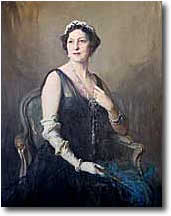
      "Widow of John de la Poer Beresford, 5th Baron Decies,  Lady Decies was the former Mrs. Harry Lehr and Mrs. John Dahlgren, born Elizabeth Wharton Drexel, daughter of the famous Philadelphia banker."  Say what?  You mean, the old dear in the middle is Elizabeth Drexel Lehr?  The one whose ravishing Boldini portrait hanging in the ballroom at the Elms in Newport I so admired just a few weeks earlier?  This cannot be!
       
      Giovanni Boldini: Portrait of Mrs. Harry Lehr, 1916

      But, it is, bringing this old Mary Petty New Yorker cover of an elderly lady dining in front of her youthful portrait to full life:


      Mrs/Lady Drexel/Dahlgren/Lehr/Decies was a famous Society figure of her day, and should not to confused with her sister Lucy, who married Elizabeth's first husband's brother and after her divorce was known as Mrs. Drexel Dahlgren (builder of Champs Soleil in Newport), .  After the death of Mr. Dahlgren, she married Harry Lehr, court jester to Newport Society, the Jerry Zipkin of his day.

       Mr. & Mrs. Harry Lehr
      Miss Harry Lehr

      On their wedding night, he gallantly informed her that he was not interested in her as a woman (or in any women), but merely in her money.  Yet they remained married and Harry continued to play women's roles in Tableaux vivants, and to exercise his rapier wit for the entertainment of Newport's grand hostesses.  After Lehr's death, she then Lord Decies, the widower of heiress Vivien Gould (who really liked cats, to the extent that she had a building for them called The Cattery on the Decies estate.  Really. Could I make this stuff up?)


      Are you still with me?  I'm just warming up.

      Mrs. Lady Lehr Decies evened the score with Harry Lehr in 1936 by writing a tell all biography, King Lehr and The Gilded Age.  I actually read it years ago.  Don't ask me why, I just did.  She seems to have been much happier with the titled husband.  And the tiara.  But the question remains:  Did she ever look as lovely as in the Boldini portrait, or was the painter, famous for making his subjects appear wittier, more sophisticated and more glamorous than they really were, just practicing his artistic sorcery?  She looks ravishing in the portrait but the evidence from other portraits is that Lady D. was actually a more ordinary sort:

       1894 by Muller-Ury
      1936 by Phillipe de Laszlo
       Weegee's photograph was not the first of the two ladies together.  Here they are at Mrs. Cornelius Vanderbilt's famous Last Ball at her Fifth Avenue Mansion in 1941.  Here we actually catch a glimpse of the Elizabeth Drexel of the Boldini portrait.

      Apparently she was downright scintillating in comparison to her arched eyebrowed companion on the left.  It was more difficult to piece together a biography of Mrs. Kavanaugh.  I mean, who the heck was she?  and why couldn't she find a better hairdresser in New York?

      I persevered, and here's what I found:

      Mrs. Kavanaugh began in Richmond, Virginia, where she was born Maria Magdalena Muller.  She married William Haberle, a brewery heir from Syracuse New York.  They lived in a drab typical upper middle class Queen Anne house on Prospect Avenue in Syracuse.  Mr. Haberle died young, leaving her with two daughters.  By 1912, she was in London with her daughter Leonora (whose marriage to a ne'er do well was a failure, and who seems actually never to have left home), and is married that year to Colonel Kavanaugh, a cotton manufacturer from Waterford New York, who became colonel while serving in Governor Levi Morton's staff.  
      Nothing exceeds like excess:  Mrs. Kavanaugh, and five pounds of jewelry in her elaborate drawing room at 10 East 62nd Street.  Not for her the graceful Louis XV of the Fricks

      Soon after, we find them living in a grand beaux arts town house at 10 East 62nd Street and beginning to appear in the Society columns.  Not for Mrs. Kavanaugh any published good works.  If she sneaked out to work in soup kitchens, it was a well kept secret.  Apparently, Society and jewelry were her main occupations.  If her portrait was painted, it isn't in the public domain, but she was photographed often, from the Beaux Arts Ball to El Morocco.  Whereas Lady Decies is well documented by photos and portraits from her early years, her buddy Mrs. Kavanaugh seems to have sprung into the world, fully bejeweled and befurred (if Sarah Palin can make up words, so can I) after her 1912 move to New York.

       In 1943, Mrs. Kavanaugh bought, for cash, the house next door, number 8, apparently to protect her property.  The value of the combined properties that year was $211,000.  Just as a point of reference, number 10 is currently valued at $22,500,000, and the far less grand number 8 at $2,160,000.

      Numbers 8 (center) and 10 (left) East 62nd Street

      In 1944, Lady Decies died, and LIFE again photographed Mrs. Kavanaugh at opening night at the Met.  As Mrs. Cornelius Vanderbilt, the star audience attraction in most seasons, couldn't attend, Mrs. Kavanaugh was the center of attention. Interviewed later about her jewelry display that evening, she explained that she would have worn more, but didn't feel it was right in wartime.  Interestingly, Mrs. Kavanaugh and Leonora sat in the front row, and not in the Golden Horseshoe, the first tier balcony where most of the fashionable set were. And their drinks (Mrs. Kavanaugh had beer, a nod to the origins of her fortune, perhaps) were had at Sherry's on the mezzanine, not in the more exclusive Opera Club.  Just sayin'.

      At El Morocco after the opera.  Daughter has certainly inherited her mother's style.
      And back to El Morocco in 1950.  Get Mrs. Kavanaugh's hat, an apparent riff on Bullwinkle

      After the Weegee photo appeared A story circulated that her grandson, William Warner, son of Leonora, was in a foxhole in Europe when copies of the photograph were dropped by the enemy, bearing the caption "GIs, is this what you're fighting for".   Warner's friend John Pierrepont set the record straight, which was that after the photo appeared, Warner had an unusual amount of mail that week, filled with clippings the friends had sent of the photo.  

      Wait a second.  William Warner?  It couldn't be.  But, yes, it is.  Mrs. Kavanaugh's grandson is the same William Warner, who wrote the wonderful Pulitzer Prize-winning Beautiful Swimmers: Watermen, Crabs and the Chesapeake Bay.  I read this book too.  Much better than King Lehr and the Gilded Age.  Much. In the introduction to his fourth book he writes of 10 E. 62nd St. that he was born "in a house without great books, without a father, and, for some periods of the year, without a mother."

      And now you know as much as I do about 'The Critic', if you didn't already.  It took me an hour to suss out this information, and another hour and a half to write it down, a half hour to choose the pictures, and it took you less than ten minutes to read it.  Lucky you. I'll never get those three hours back

      Speaking of A Night at the Opera, here is Margaret Dumont with the Marx brothers on a disastrous opening night in the 1935 movie.   Looks familiar, doesn't it?   The silly socialite, living only for jewels and being seen at the right places was a standard cliche of old comedies, and one glance at Decies and Kavanaugh makes it easy to understand why.


      7.12.10

      Peter Pennoyer Down East

      For almost every decade of the last century, one of the standard arguments in design has been new vs. old.  On one hand,  modernists insist that new is the only true religion, and that copying is bad.  On the other, traditionalists will put a gable roof on anything from cabin to shopping mall, and be satisfied that their God is being served.  Both sides have their points of course, but in the end, to my own eye, only one question matters---modern or traditional, is it good?  And in the last twenty years, as big traditional houses have come back in fashion, that question is more pertinent than ever as huge palaces of vinyl and sheetrock  have risen across the country, blighting the landscape wherever they land, often replacing older and better houses.

       Rendering of a house in Massachusetts, from Peter Pennoyer, Architects.  Described as 'Federal' in the book, it more fairly reminds this writer of the smaller houses of Philip Schutze.

      Stair hall in the Massachusetts house.  Graceful in design & execution (I especially like the boxed treads and landing above the arch), its location in the center of the house recalls Ogden Codman's Berkely Villa at Newport

      The reason I mention this is that I recently received a review copy of Vendome Press's new monograph, Peter Pennoyer, Architects, by Anne Walker, Pennoyer's collaborator on previous monographs about Delano and Aldrich, Grosvenor Atterbury, and Warren & Wetmore, and as I turn its lush pages, the question of tradition vs. modernism is foremost in my mind.

      Mirrored Entrance Hall leads to central stair hall
       
      Mr. Pennoyer first entered my consciousness years ago, when his country house for Louis Auchincloss was published.  It was an interesting house, designed for a book lover, traditional, based on Swedish precedent, and with more than a nod to post-modernism in its interiors.  Since then Pennoyer's houses have grown increasingly pure in their traditionalism, and exponentially larger and more expensively detailed, following exactly the pattern of wealth redistribution that has overtaken the country.  When looking at one of Pennoyer's designs, one is transported back to those halcyon years before the great depression, when understated but lush country houses were being built on Long Island, and quiet, elegant townhouses rose on the upper East side.  Mr. Pennoyer's architectural world recalls sleek limousines (not limos), silver cocktail shakers and Lanvin gowns, and nobody practicing today does it better.

      Drawing Room in an upper East Side town house betrays no sign that it was not built and decorated in the 1920's

      And herein, as I carefully examined each house pictured, trying to keep thoughts of revolution, or at least tax reform, from clouding my critical judgement, I had what was for me an interesting revelation.  And that is, that the houses that Mr. Pennoyer and his peers are creating for the latest generation of plutocrats, impeccably detailed, beautifully crafted, are interesting, not just for themselves, but because they are a new generation of the type---based not on early precedent, but rather on the latter work.  Thus, if a 1920's Long Island country house of classical Georgian design draws its inspiration from 18th century English precedent (or 17th century  England or Italy, or 18th century France, pick a style)---Jane Austen meets the jazz age, if you will---and the 18th century house in turn evoked ancient Rome, Pennoyer's houses go back to the latest model, and give a new, respectful version for the 21st century of the sophisticated, tasteful, architecture of ninety years ago.  In short, think if Ogden Codman channeled Blondel, Pennoyer is channeling Codman channeling Blondel.  This was brought home to me by a photograph caption, which gave inspiration for a beautifully carved Corinthian capital to Clarence Hanson, the carver who did much of Philip Schutze's millwork, rather than to the 18th century carvers who in turn inspired Hanson.

      Stair hall in upper East Side Town house, again, purely evoking the pre-depression past

      The best of these houses are beautiful indeed, with a level of correctness in design (no shortcuts taken here, moldings are full and complete, curving staircases sweep beautifully skyward), and a sure sense of proportion that is rarely seen in traditional architecture today.  These are buildings meant to convey a message of taste and luxury, of money that is correctly spent, and that rebuke the sprayon stucco chateaux and palazzi that have appeared across the country, in this latest gilded age, filled with Real Housewives waiting for their closeups.

       Channeling Delano & Aldrich--a Georgian paneled drawing room mixes with neoclassical in its oval shape, and acanthus grilles above the windows

      If I have a quibble with the Pennoyer firm, it is that they are almost too respectful in their homage, and missing is the light anarchy of some of his heroes---the sublimely elegant reductionist designs of Delano and Aldrich, who made traditional so modern, or the picturesque and materials-oriented Atterbury, or the over the top, rule-breaking Warren & Wetmore.

      But these are small quibbles indeed, and for this Down East Maine boy, the issue was brought home by a very large shingled summer house that Pennoyer designed on an island not far from here.  Variations on the Shingle Style have been the favorite of big new houses up here for the last two decades, and many of them are just bad---overwrought, over detailed, and over constructed.  Too many of these wannabes borrow too much from the famous examples, and are turreted, gabled, Palladian windowed and gambrel roofed within an inch of their over-designed lives.   This house takes it down a couple of notches---paying close attention to the local vernacular---and succeeds admirably, addressing its site and the conditions of the region, with none of the cliches that characterize much modern shingle work
       
        A shingled summer house on an island overlooking Penobscot Bay in Maine pays careful homage to the local vernacular without falling prey to standard cliches

      The production values and photography in this book are first rate, as is Anne Walker's text., a welcome contrast to several recent design books.  As one would expect with a monograph of a living architect, critical assessment is beside the point, but the book is beautiful, and thought provoking, nevertheless.  I was especially delighted with the inclusion of several splendid renderings and sketches illustrating the Pennoyer firm's couture approach to design.

      What could be more perfect than a library with a secret door?